

by Rodrigo Ballon Villanueva
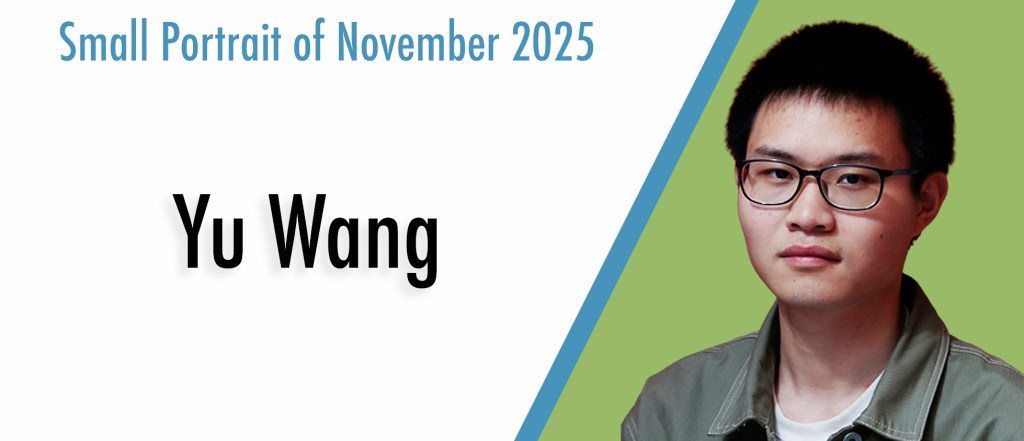
Yu Wang
As the end of 2025 is almost upon us, the IPM team has begun considering how to be better next year. Thus, it is only appropriate that this month’s small portrait features the work of Yu Wang, who is a specialist in ancient ethics and moral psychology!
Yu earned a BA in Philosophy (2021) from Zhejiang University (China), with a dissertation on MacIntyre’s historicist revision of Aristotle’s ethics. He also holds an MA in Philosophy (2024) from Renmin University of China. This time, his dissertation argued that Aristotle postulated the identity between his notions of deliberation and practical syllogism. Currently, he is a second-year PhD student at the Munich School of Ancient Philosophy (Germany, LMU), working under the supervision of Christof Rapp. Yu’s thesis focuses on early Stoic action theory, especially on the role of the ‘impulse’ (hormē) as the starting point for action.
Additionally, Yu investigates the transmission of Western ideas to China carried out by the Jesuits during the late Ming and early Qing periods, with a particular focus on the reception of ancient Greek philosophy and its interaction with Chinese philosophical thought. Furthermore, he is strongly interested in the relationship between the astronomical and temporal consciousness embodied in Chinese characters and their role in the development of early Chinese philosophy. Yu maintains that thinkers in ancient China encoded their understanding of time, the heavens, and natural order into written symbols. Hence, the study of these reveals profound insights into such a worldview. Accordingly, Yu greatly appreciates Chinese calligraphy, both in its practical and theoretical dimensions, as it unites artistic expression with philosophical reflection on form, rhythm, and harmony.
If you want to know more about Yu’s research, feel free to contact him at yuwang398@gmail.com!
©️Rodrigo Ballon Villanueva | “Yu Wang”, IPM Monthly 4/11 (2025).
 IPM Monthly