

The Calculators Tradition in Natural Philosophy: An Interview with Daniel Di Liscia
By Guido Alt
February 2025 – In this issue of Philosophy and Academy, we are joined by Daniel Di Liscia in Haifa to discuss the calculators’ tradition and its impact on the history of philosophy and science. Daniel walks us through the importance of the calculators’ movement in natural philosophy, as well as in logic and mathematics. In our interview, we also explore its connection to the history of early modern science. Daniel has dedicated substantial research to these topics, and discussing these fascinating issues with him only makes me want to continue this conversation – perhaps in the kind of pub conversations that we all enjoy after a long conference day. The only drawback of this interview (besides not being in a pub) was a series of technical issues that caused some short interruptions in the recording. To address this, we introduced on-screen text in the video whenever the camera shut off, verifying the missing content with Daniel post-interview. We hope you enjoy it as much as I did!
About Daniel Di Liscia
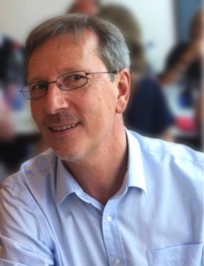
Daniel Di Liscia is currently a visiting researcher at the Technion – Israel Institute of Technology. He is also affiliated with the Munich center for Mathematical Philosophy. His work primarily focuses on the late medieval tradition in physics, logic and mathematics, as well as its connection to the history of early modern science. He has worked extensively on the calculators’ tradition, and has most recently co-edited the volume Quantifying Aristotle: The Impact, Spread, and Decline of the Calculatores Tradition. You can read much more about his published work and research interests in his LMU Munich webpage.
The Interview
Guido Alt: Daniel, thank you so much for accepting to do this interview for us at the IPM. I’ll briefly introduce you before we move on to the questions.
Daniel Di Liscia is a visiting researcher here at the Technion, Israel Institute of Technology in Haifa, he also is a researcher at the Munich Center for Mathematical Philosophy. His work is dedicated foremost to late medieval physics, logic and mathematics, as well as to the early modern history of science. We’ll touch on some of these topics today.
Guido Alt: The first question I’d like to ask is about the calculators.
Daniel Di Liscia: I love them.
GA: Yes, you’ve done a lot of substantial work on the calculatores project. One example of this is the volume that you co-edited on Quantifying Aristotle. Could you tell us who were the calculators, and what is the importance of that movement in the history of philosophy?
DL: Yes, ‘calculators’ is a denomination which is a topic for discussion in itself. Because we use it, and this is correct. But you know, we historians of science and of philosophy apply backwards some characterizations for groups. And they are not without problems sometimes. So, take, for instance, a completely problematic characterization such as ‘Buridanism,’ which has been a subject of discussions which I think are especially correct. If you take also the notion, for example, of nominalism, which is also an issue, and there have been many publications on that, on whether we should use it and in what sense, etc.
The calculators are especially interesting because we find the characterization “calculators” in the sources. So, there are other people saying what they mean by saying calculatores. So there was a group characterization that arose in the second generation already, when it was was normal to say calculatores. And the quotation refers really, as we can verify, it directly connects to Heyetesbury, Swineshead and so on. The author of this denomination is John of Holland, who was a Master of Arts and worked a lot on logic. It is another issue whether we can identify this John of Holland with a musician or theoretical musician of the same period, working also in eastern Europe. In any case this John of Holland mentions, in one of those works, “as the calculatores say.” I’ve found another quotation in another work of the same John of Holland in his Sophismata, which is very interesting. So, we have this historical background, which is objective. And the most obvious connection is the calculator Richard Swineshead, named like that because of his so-called Liber Calculationum. So, people identify this person with this book, and on this book, there is beautiful work done by Robert Podkoński, about the transmission of the text, which is quite complicated. If you take that whole as being a book called Liber Calculationum, and you identify it with Richard Swineshead, then you have an idea and example of what people are doing or meaning when they talk about the calculatores, namelythis kind of approach.
What kind of approach is this? There are different ways to describe that. I think that the most interesting and the most modern way to describe the calculators’ approach to science and philosophy is by mathematization, or better said quantification. Because mathematics is a way of quantifying things, but it is not the only one. Then, you are accentuating and emphasizing those aspects of traditional Aristotelian science which were able to be discussed in terms of quantities. To this goal, you can use mathematics, and you sometimes must use mathematics, just like other tools such as the modal logic of that time that you can apply to it. So, the discussion of, for instance, the starting and ending of processes and of changes, is not necessarily a mathematical topic. You can approach that in logic, in theology, and also of course in natural philosophy, relate it to some passage of Aristotle where he talks about that, especially a short passage in the eight book of the Physics, but also of course in the sixth. This is not a strictly mathematical problem, but the background is of course the conceptualization of continuity, infinity, which are at least half mathematical notions.
There you also have very strictly mathematical fields. I like very much the denomination or the way to describe that introduced by John Murdoch, where we say ‘analytical languages’ or ‘languages of analysis.’ This is a really intelligent way to describe it, because that means those people were working on those languages, and if you were able, if you really were capable, of understanding all of its details within a field, you were able to transpose those problems and methods to other fields. So, you can talk about incipit and desinit, or explicit and desinit, which is an approach that is a little bit more logical. But you can also do maxima et minima, which isanother field of those analytical languages. And there is one which is strictly mathematical, which is the proportions of motion (proportiones motum). And there, people really needed mathematics. Of course, it is not our mathematics, the theory of proportions is in a sense an “easy” mathematics, with some tricks related to Euclid’s Elements, book V number 5-7, and related also obviously to the tradition of Boethius’ arithmetic.
So, that is strictly mathematics but again applied to physics. The problem was motion, and basically the problem and most interesting point was acceleration or the changes of intensity. I think that is the most interesting point in the calculators’ tradition, the discussion and the trying to go deeper and deeper into this notion of intensity (which is not Aristotelian, that is the point). Of course there is an Aristotle connection here and there. But there is no treatment of intensity in terms of a chapter somewhere in which Aristotle discusses the “intensibile” behavior of qualities, he doesn’t do that, and you don’t find that in Aristotle. And these people came around the corner through the theological tradition of the commentaries on the Sententiae, and here you have all research done first by Pierre Duhem, and then by Anneliese Maier, and so on. But I think that is the only field which is most general, because you can always find the (language of) intension and remission, and also the most problematic, because you need to put change into proportions, so that they become functions in some way. And it is also the most tricky and interesting field, because this produces so-called series, if they (the proportions) move in time. This is one of the most fascinating aspects, but not the only one.
GA: Putting your research subjects chronologically and thematically in a later period, you’ve also worked on the Kepler commission of the Bavarian Academy of Sciences. That involved editorial and scholarly work on the philosophical aspects of Johannes Kepler’s work. One output of that is the SEP entry that you wrote on Kepler. We think about the scientific revolution often as a sort of moving away from Aristotelian philosophy and I was about the philosophical aspects involved here.
DL: That is the problem, yes. There are many problems here. One that you are mentioning is a really big one, namely this moving out from or moving through Aristotle’s commentaries. How is that? When I started working, and this is a little bit biographical, but I was very fortunate to have had excellent supervisors. Not only in Germany, where I wrote my PhD, but especially also in Argentina. There was Silvia Magnavacca, Francisco Bertelloni, and Guillermo Ranea, an outstanding Leibniz scholar. And they pointed me to work that was happening about the late Aristotelians. From that time there was Charles Lohr working on, in connection with Eckhard Keßler, who was later one of my supervisors at LMU Munich. I got to know William Wallace and read all this. My supervisors in Argentina, they used to said that I needed to study that. And I remember both saying to me that I needed to learn French, because there you have the works of Duhem, there was no way around it, you need to read it. And they said I needed to learn German to read Anneliese Maier, and for my work also the papers by William Wallace. There was not only him, but he was working on the connection of the transformation of Aristotelian natural philosophy into Galileo’s first writings. Charles Schmitt was the background on Aristotle and the Renaissance. So, I started working on this and then I went to Kepler, the Kepler Commission was a very challenging time for me, but I’ve learned. And Kepler wrote on Aristotle, translated partially De Caelo, and commented on it. So this is important.
One of my first research papers is exactly on this point, and I’ve found that there was a problem there of how Kepler reworked the Aristotelian notion of the demonstrations quia and propter quid. I had been working before on the calculators’ tradition, and this was a major topic for the transmission of the calculators’ results to the centuries later. Coming back to the first question, we talked about the calculators’ tradition, and I do that when I talk about the calculators. Today this is obvious, but for a long time it wasn’t. So, I’ve tried to define myself, my work and efforts, with this idea of the calculators’ tradition, going from Bradwardine to Leibniz, of course there were a lot of changes, locally and temporally. Before people talked about the Oxford calculators, first there was the Merton calculators, and then that was broadened and widened. I think we can talk about the calculators’ tradition in general if we are able to analyze and identify their ways of transmission and their differences, it is not always the same.
So, one of the points of transmission starting from the first generation and going through history until Galileo on this, at the same time (but I’m not saying Galileo did that), was that this ‘analytical language’ of the proportions, proportions of motions, was transmitted in terms of the analysis of the motion according to the causes, and according to the effects. And that has been conceptualized in the history of science, kind of anachronistically, in terms of dynamics and kinematics. I was more critical of this. I thought, why should we do that, if we do have a very clear Aristotelian methodological precept telling us to start with the effects, and then we try to work out all the way through the effects to the causes. And then, when we arrive to the causes, and not until there, we have science. Because science is knowledge through causes. You find that this kind of distinction, quoad effectum/quoad causam, was being made to introduce the whole topic into the Physics commentary tradition. The case of Albert of Saxony is interesting, for instance, because Albert of Saxony wrote a treatise on proportions, and he deals first with causes and then with the effects, as he himself says. And then, in the Physics, he says that we have to adapt according to what we’re doing in this commentary, first treating the effects in the 6th book of Physics – the effectsof motions in terms space and time -, and then the causes, which is in the 7th book, about the ‘dynamic’ rule of motion, using resistances, and forces or powers. So that makes sense. And then you would see the same distinction taken over by Paulus Venetus (Paul of Venice), and then again, mentioning Paulus Venetus, in Domingo de Soto. Domingo de Soto is the only one who could use that to describe the motion of the falling bodies, and there is the issue of whether Galileo used that also or not, the so-called riddle of Domingo de Soto. If you want to analyze this riddle, you need to know that this transmission, coming from Oxford, is all about a horn of the distinction ‘according to the effects/according to the causes.’ Only through this way it arrived in the Physics commentaries. By the way, the same distinction was used also to describe treatises. For instance, it was used by Alvaro Thomas in this way, the great Portuguese calculator par excellence in the later times.
So, I started to reflect about the issue of Kepler using this geometry of the five regular bodies to reconstruct the whole structure of the universe. I’ve read the English translation, and the Latin text, and the translation seemed to be saying something else. In the Latin, he was clearly saying that the Copernican view of the world is correct, but the way it has been defended up until now, through the Tabula Prutenicae for instance, is just a question of facts, it is a question of the effects. But the causes for that needed to be found in the geometry of the polyhedra. And he used this propter quid and quia distinction for that. So, he is using, at least in rhetoric, but I think it is more than rhetoric, the conceptualization according to which we have a fact, and the fact is that the world really is a Copernican construction, that the Copernican system of the world is correct, but we don’t know why. So, why? Well, because God is a geometer. But that is not enough, because what is the connection here with God being a geometer (which is a wholly Platonic tradition and that has always been said)? The connection is that he uses the five polyhedra, and using the five polyhedra, for instance the distances, the velocities, and the very fact that there is this number of planets and not more (which was wrong, as we know now), but this very fact that there is this number of planets is given by the fact that there are so many polyhedra. So, there is a reason, a necessary reason for this fact. So, the idea was that from an Aristotelian point of view we can be Copernicans, because we have the reasons for this and not only a description.
By the way, if you stay only with the description given by the facts, the numeric tables and the Tabula Prutenica, you can always have errors of measurement, and there were. So, this is not something you can trust. And a scientist should have a deduction of the so-called laws. This is the difference between Maxwell and Faraday, right? You have the deduction of describing equations, and you have a cause, so this equation is correct because of that. You don’t need that, but Kepler was of the opinion that it is nice to put God behind that, why not? That was for me the connection. So Aristotelian science was important, but I don’t think, and this is my point of contention with many who had worked on this background by then, especially with Wallace, I don’t really think that the most important results of new science can be reduced to principles of Aristotelian methodology. Or of any methodology at all, since it is much more than methodology.
So, the point was, closing the former issue, that this novel analysis of motion and of speed, was kind of an important move for the legitimation of the calculators’ results, which were conveyed basically in the field of logic and in the sophismata. And logic is not a real science, it is a tool for sciences, and the sophismata are even less so. Of course, you need to learn and to exercise them, but if it is going to be a real science and it is going to be transposed into physics, you need a way to transpose from one to another. And it was a very important move to find the quoad causam/quoad effectum. However, as I was saying, I don’t think the methodology is in general decisive for science. That was a little bit the point of my disagreement with this approach of emphasizing Aristotelian methodology as the background for the new science. I don’t think so, I do really think that in analyzing the most physical and ontological notions, we find that there is real difference and a break in many aspects. This is why I think the work of Anneliese Maier is still very interesting and very useful.
GA: That is very interesting because one question that comes to mind concerns some of these points of discontinuity, maybe in the field of physics, between medieval scholastic and then early modern physics. Can you tell us how you approach these ruptures that happened here, aside from the issue of methodology, which you just mentioned.
DL: I think this is a huge point. But if I need to mention some points, I’d say that we need to distinguish between the conceptual and internalist approach, and the more externalist approach. I cannot do all, but I should have mentioned that in the introduction to Quantifying Aristotle, because I say that, that we need to be at least aware of the fact that we all, in this book for instance, we’re writing papers in an internalist way mostly, except one paper by Richard Oosterhoff. In general, this is one approach, but it is not enough, since all the time there were things happening out there you know. When Oresme was there in Normandy, Bradwardine was ambassador of the English nation in France, and there were books going back and forth. I don’t think that this is just a history of notions alone. That is in any case unacceptable for the scientific revolution. I’m not saying anything new; we don’t have to go extremely externalist, but if we take the work of great scholars on Newton, you will find that some of them emphasized this aspect, and the same goes for Galileo. I think this is important for Kepler too and so on, patronage structures and this kind of thing. I’ve noticed that in Kepler when working on the edition of a manuscript on the water pump. It was a technical device, and it was not an academic issue. There is where you find a limitation of the tradition of the calculators, which was basically a tradition within the universities, an academic tradition.
So, we are talking about how the calculators’ tradition was getting weaker and weaker, and transforming itself in a nonproductive way. The research program became regressive, in Lakatos’ terms. Why? Well one point is this. It was an academic tradition, and as an academic tradition, at some point it was not very creative. Science moved to scientific academies and away from universities. And in the calculators, we see that this mathematization did not have a connection to real life in two senses. First, there was no connection to financial mathematics – and you know, algebra is related to that, the origins of European algebra relate to that. And the other point is the connection to real life in the sense of objects of mechanics, there’s only minimal connection with that also. The impetus theory was connected with describing canons, in Tartaglia for instance, but there was no such thing in the calculators’ tradition. You can find that Leonardo da Vinci wrote on proportions, but that is not enough.
Then there is another cosmology, that was the point, a new cosmology determining really the field of discussion. I think that all those aspects are present in the later calculators’ tradition, this is more of a repetition and going to the logic and the philosophy of language, until this program got heavy munition criticisms from the humanists. And they changed the structure of education, so that logic was no longer usual, nor was the sophismata tradition, and so on. I think Edith Sylla emphasized that in one paper and I think it is important to say that. The other point is that humanists such as Vives, for instance, really attacked it, with some questionable reasons and some really serious reasons. For example, the question of the application of all that is, what is it for? If it is going to be about the structure of continuous, that has already been done, so there’s nothing new. So, what is the application here? Nothing. Can you apply that to virtues and to ethics? You can’t (according to his criticism). So, at some point it became only historical curiosity, and Leibniz, who represents the last step in this development, is a little bit different because, he was looking back and warning to the Cartesians that we need to pay attention to the notion of intension of velocity, to the notions of intension and remission of qualities, and that had been done by the scholastics, especially by Swineshead etc, but I think he was an exception.
GA: That is fascinating, we could go on and on about this!
DL: We could!
GA: But turning to another question, what are some of the recent projects you have been working on?
DL: Too many! One thing that I want to mention is Jacques Legrand. I’ve written this book, and I want to find somewhere to print it (because we need to pay for it and I don’t have money), which is difficult because this is going to be 450 pages with the edition of Legrand’s Compendium on natural philosophy, which is a fascinating book. He was a fascinating personality, and I was very happy to work on that. I hope to do something on this still, because I’ve discovered a little piece which I think we can attribute to Legrand. It is not a copy of something, it is a writing, which is interesting.
Of what I’m working on now, the most important aspect is the geometrization of motion, which has been my topic for years, the tradition of the latitude of forms, geometrization of motion, and I will start with a new project on that. I’ve worked for many years on the German tradition of all those manuscripts and commentaries on the latitudines formarum, in Vienna, in Germany and so on, and I’m going to work on the Italian tradition, including Biaggio Pelacani da Parma (Blasius of Parma). Another really important and urgent project that we are working on and hope to finish soon in this year is the critical edition of and commentary on Jacques Almain’s Embammata Physicalia. This is a really interesting project because of the renewal of the calculators’ tradition at the University of Paris in the beginning of the 16th century. After the Humanist criticism, they came back with John Mair, and they developed really into a huge calculators team, expanding over with Gaspar Lax, the Coronel brothers, and Jean Dullaert of Ghent, all working on this program. So, we are preparing this edition. I’m also preparing a long paper about the conclusio mirabilis by Oresme, which is a very interesting analysis. We attribute that to Oresme, it is not entirely certain, but it is pretty possible that he was the author.
In the background I always have two books on my mind, one of which is exactly on this problem of continuity. I need to learn more about other problems, especially about the notion of experience in the late medieval philosophy and in the Renaissance, the notion of empirical science is for me more important at the moment. The other one is a big general introduction or problematic presentation of the calculators’ tradition, that would get the very neutral and ‘boring’ title The Calculators Tradition from Bradwardine to Leibniz, presenting what I take to be the main lines of development. There are a lot of good people working on that, such as Elżbieta Jung, Robert Podkoński, Sabine Rommevaux, to name some names of people I know best. I’m not alone! I don’t know if I’m going to finish that one day, but I am trying.
GA: Thanks Daniel, this was a fantastic conversation, those are fantastic projects and thank you for your time to give this interview for us.
DL: I have to say thanks, thank you!
©️Guido Alt | “The Calculators Tradition in Natural Philosophy”, IPM Monthly 4/2 (2025).
 IPM Monthly