

Platonism and Medieval Studies: An Interview with Alessandra Beccarisi
By Francisco Iversen
December 2025 – In medieval studies, the reception of Platonism is a complex and non-linear phenomenon. It involves a mixture of traditions, misinterpretations, and mistranslations, where the aspiration to remain faithful to the auctoritas often gives rise to new philosophical developments. To shed light on the reception of Platonism among German authors, and to reflect on a life dedicated to medieval studies, we spoke with Alessandra Beccarisi.
About Alessandra Beccarisi
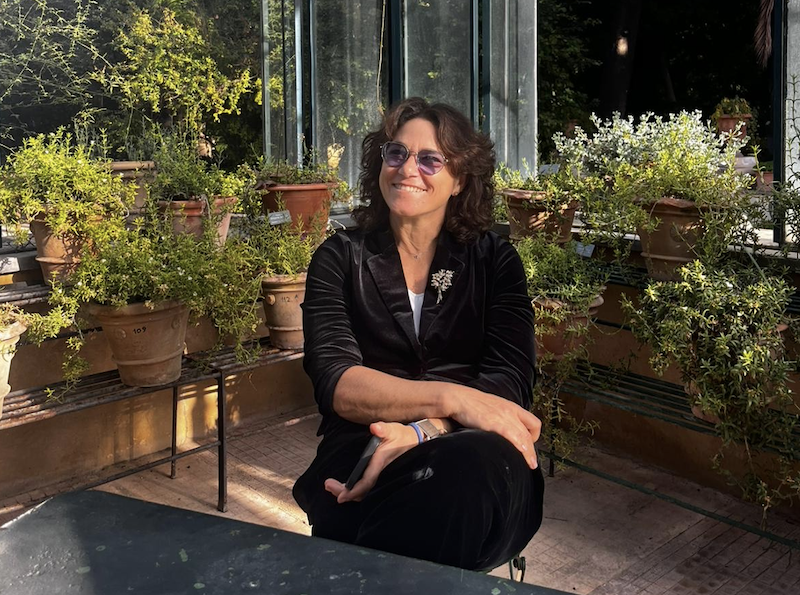
Alessandra Beccarisi is Professor of Medieval Philosophy History at the University of Foggia, after more than twenty years of teaching at the University of Salento, where she was a disciple of Loris Sturlese. She is an active member of several international research networks in medieval philosophy. Her work focuses particularly on German thought in the 13th and 14th centuries, with special attention to Meister Eckhart, Dietrich von Freiberg, and the reception of ancient philosophy in the Middle Ages. She is the general editor of the series Rencontres de philosophie médiévale and the Bulletin de philosophie médiévale published by the Société Internationale pour l’Étude de la Philosophie Médiévale (SIEPM).
Beccarisi has been a visiting researcher and fellow at leading institutions such as the Alexander von Humboldt-Stiftung, the Universität Hamburg, the Universität zu Köln and KU Leuven. She is actively involved in European and international projects on the transmission of philosophical knowledge in the Middle Ages. She also serves as an evaluator for several research agencies, including Argentina’s National Agency for the Promotion of Research, Technological Development, and Innovation .
Her numerous publications and critical editions on medieval philosophy and its ancient sources combine a philological approach with doctrinal analysis.
The Interview
Francisco Iversen: What would you say is the most fundamental thing you learned from your mentor Loris Sturlese?
Alessandra Beccarisi: The most fundamental thing I learned from Loris Sturlese is a method — a way of approaching medieval texts with rigor, intellectual discipline, and an attitude that one might rightly call scientific. He taught me that the history of medieval philosophy requires a precise and faithful reading of the sources, without giving in to the temptation of “updating” them — temptations that, in this field, can be particularly dangerous, both in positive and negative ways.
He also showed me that such rigor is not at odds with passion: the more respectful and exact our reading of a text is, the deeper and more alive our relationship with it becomes. Finally, he instilled in me the conviction that a true scholar never isolates herself. One belongs to an academic community, assumes responsibilities, and contributes to sustaining the structures and contexts that make collective research possible. Doing serious scholarship is not a solitary act — it is a shared commitment and, in a way, a political one.
FI: What are you currently working on?
AB: At the moment, I am pursuing three main lines of research. First, the relationship between metaphysics and practices of knowledge in the late Middle Ages, particularly in the work of Meister Eckhart and his Dominican context. Second, the thought of Bartolomeo da Parma and the circulation of astrological and geomantic knowledge in the medieval university. And third, more broadly, I am interested in reconstructing the genealogy of certain forms of European rationalism, exploring how categories that shaped modernity have deep medieval roots.
FI: In light of your involvement in international societies such as SIEPM, why do you consider international collaboration among scholars important?
AB: International collaboration is not simply an addition to research: it is one of its vital conditions. Engaging with colleagues from different traditions not only broadens horizons but also transforms the very questions we ask, reshapes our categories, and pushes us beyond the comfort of the familiar.
I like to recall a phrase by Eugenio Garin — mentor to Loris Sturlese — who described intellectuals as “citizens of the same res publica.” This captures perfectly what networks such as the Société Internationale pour l’Étude de la Philosophie Médiévale mean to me: a shared space where knowledge is collectively built, beyond linguistic, national, or institutional borders.
Being part of this res publica litteraria also carries a sense of responsibility: not only to participate, but to contribute actively to keeping it alive.
FI: Regarding your editorial work with Rencontres de philosophie médiévale and the Bulletin de philosophie médiévale: what do you consider the most challenging aspect of this work, and what would you recommend to someone starting in this field?
AB: The greatest challenge is balancing the highest scientific standards with genuine openness to diverse research perspectives. Serious editorial work is not merely technical: it means reading carefully, engaging in dialogue with authors and reviewers, and taking responsibility for the scientific coherence of an entire series or journal.
To those who are just beginning, I would say: do not underestimate the collective and often invisible dimension of editorial work. Editing is, in a way, a form of caring for the scholarly community. It requires patience, constancy, and a strong sense of responsibility, but it is also a space where knowledge is built in a deep and shared way.
FI: Would you agree that we are all either Platonists or Aristotelians? What, in your view, is the most fundamental difference between these two groups, and with which would you identify?
AB: It is, without doubt, an intellectual provocation — but also a great simplification. Still, I’ll accept the challenge. If I had to place myself within this dichotomy, I would be closer to the Platonic side. For although I fully share — as Garin and Sturlese have taught — the conviction that philosophy exists in history, I cannot resist the fascination of principles and universal structures. Part of the strength of the Platonic tradition lies precisely in that tension between the historical and the universal, between the contingent and the necessary: a tension that should not be resolved, but rather inhabited.
©️Francisco Iversen | “Platonism and Medieval Studies”, IPM Monthly 4/12 (2025).
 IPM Monthly