

‘Philosophising with the Greats’
Can we, today’s philosophers, profitably dialogue with the ancient (and medieval) ones? An Interview with Anna Marmodoro
by Rodrigo Ballon Villanueva
June 2023 – There is a long-standing ‘fracture’ among the philosophical community, divided into the so-called ‘analytical’ and the so-called ‘continental’ camps. One dimension along which the two groups are perceived and perceive themselves as different concerns their relation to the history of philosophy. Continentals have often accused analytics to be ‘ahistorical’ or, even worse, ‘anti-historical’. On their part, analytics consider continental scholarship as mere doxography in opposition to ‘proper’ (i.e., analytic) philosophy. It seems like upcoming philosophers have no alternative but to pick a side. Is it so? In this interview, Anna Marmodoro will address this question on the occasion of her recent research stay at the University of Notre Dame.
About Anna Marmodoro
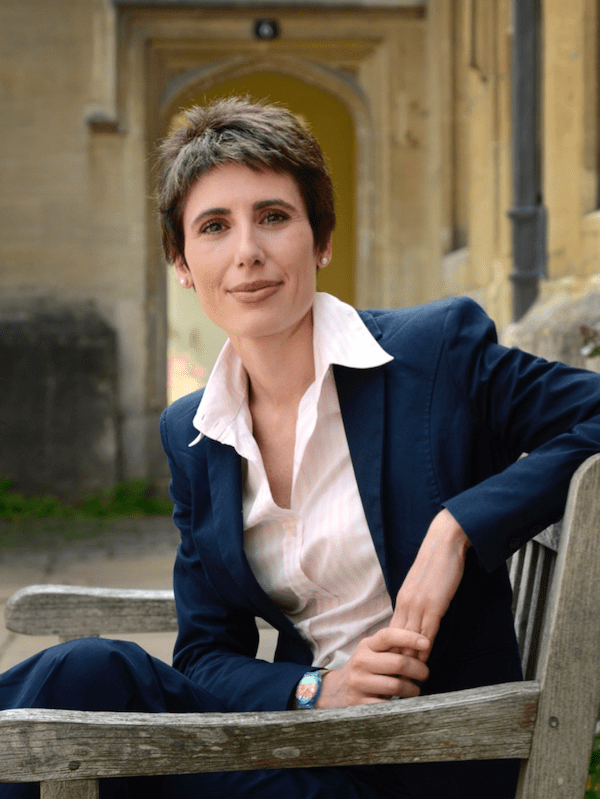
Anna Marmodoro is Full Professor of Philosophy at Durham University, where she holds the Chair of Metaphysics since 2016. Concomitantly, Anna is an Associate Member of the Faculty of Philosophy at the University of Oxford, where she worked for a decade before taking her current position. She earned her PhD at Edinburgh University in 2006, and her MA at the University of Pisa in 2000. She has held several visiting positions internationally, in Europe, the U.S. and Australia. Anna specializes in two main research areas: on the one hand, analytic metaphysics, and on the other, ancient, late ancient and medieval philosophy. She has also strong interests in the philosophy of science and the philosophy of religion. She has published monographs, edited books, and journal articles in all these fields. Her latest monograph is Forms and Structure in Plato’s Metaphysics (Oxford University Press, 2022). She is currently finishing a new one, titled Properties in Ancient Metaphysics, under contract with Cambridge University Press.
The Interview
Anna, you recently spent some time as a Distinguished Visitor at the History of Philosophy Forum of the University of Notre Dame (ND), with a project titled ‘Metaphysical Issues in Classical and Late Antiquity’. Could you tell us a bit about your experience there?
Thank you for this interview; I am pleased to speak about my experience at ND. A few words first explain what motivated me to seek such an experience. I firmly believe that academic work is something we can do better collectively. I am convinced that is always very helpful to share thoughts with other scholars to broaden one’s horizons, to improve one’s results, etc. In this spirit, I was delighted to receive an invitation from ND to visit their philosophy department because they are an internationally renowned, very strong philosophical community, both in the history of philosophy and contemporary philosophy. In ND, I was invited to hold two workshops on my manuscript in progress, titled ‘Properties in Ancient Metaphysics’, and give a research talk. With respect to the book workshops, I sent in advance a draft of the manuscript and then held discussion sessions open to colleagues and graduate students. This experience was incredibly helpful to me. I am currently working on the final version of the book, which will be a better one thanks to the comments I received.
With respect to the research talk, I chose to present completely new material, on what I call ‘Parmenidean Essentialism’. Again, the feedback received there is proving to be extremely useful to improve my work. Colleagues were interested, open, exploratory of my new ideas, and friendly in their criticisms.
In addition, the very fact of being part of the ND community and being able to participate in their activities – from seminars to individual meetings with colleagues and graduate students – was fantastic. I attended talks about many fascinating topics in ancient and medieval philosophy and the philosophy of religion.
Overall, the experience at ND was wonderful, with the extra dimension that their campus is an incredibly peaceful place. Self-contained in a beautiful very green area, by a majestic lake. The tranquillity I experienced there was an extra bonus for my own work.
All that sounds lovely. I am looking forward to visiting ND myself! Would you be so kind as to share with us more about your upcoming book and the research paper within the framework of your project there?
Like many other academics, I would say, I started with an idea about what I would be doing at ND during my stay, but my research had evolved by the time I got there. Initially, I thought I would work on different papers, devoted to Augustine and Gregory of Nyssa, respectively. But, in the end, when my visit was approaching, I had the manuscript of my new book on Properties in Ancient Metaphysics nearly ready. In agreement with my hosts at ND, I thought it would be best to push on with this project during my research stay (the paper on Gregory of Nyssa got completed before my going to ND, and the paper on Augustine got postponed to 2024).
My book examines the origin of what we call today ‘the metaphysics of properties’, and it does it in some interesting ways, I believe. The ‘standard’ view is that the two main players in the debate on the metaphysics of properties in Antiquity are Plato and Aristotle. They both believe in universals, but Plato in transcendental universals and Aristotle in immanent universals. In the book, I argue that we should actually consider three main players, adding Anaxagoras to the list. I claim that Anaxagoras thought of properties as particulars, whereas Aristotle as universals. Plato is in between them, not only chronologically but also conceptually. Let me not give a spoiler away here, concerning how I think Plato conceives of properties… in case people want to read the book! This is the main thing I worked on during my research stay in ND: completing and polishing the book manuscript.
The second thing I did was, as mentioned, to write out and present a research paper titled ‘Parmenidean Essentialism’. In the paper, I argue among other things that our present-day understanding of ‘essentialism’ (i.e., the theory that objects have properties that belong to them essentially) is not how Aristotle actually thought of essentialism. There is a mismatch between contemporary essentialism – which is generally thought to derive from Aristotle – and what Aristotle really thought. This is one of my claims in this paper. No other spoiler given here. Presenting this paper within a community such as the one in ND was extremely helpful because the paper spans ancient and contemporary metaphysics, which are areas of strength at ND. Once again, I want to say that I am incredibly grateful for the feedback I got there.
This is really fascinating and I, for one, cannot wait to read both works. You just mentioned something for which you are internationally known, namely, to work at the intersection of the history of philosophy and contemporary metaphysics. In this line, you are launching along with other excellent scholars a new series in Oxford University Press titled ‘Library of Early Christian Philosophy’. What is this project about?
That is a great question, thanks for it. I am generally interested in (broadly speaking) rethinking the boundaries that we have given ourselves in our research field. You mentioned that one of my interests is to show that there is space for, as well as value and utility in, opening up a dialogue between those working in the history of philosophy and those working in contemporary philosophy. Now, rethinking the boundaries of our field can be done along another dimension too, and that is to expand the so-called canon. Traditionally, the main ancient philosophers we study and teach are Plato and Aristotle and maybe also the early Greeks, the Stoics, and the Sceptics but the latter group with much less… intensity. (I am thinking of the Oxford curriculum for example). This, however, is a limited approach considering the number of thinkers in Classical and Late Antiquity who have been influential on the following developments of the history of philosophy. So, with other colleagues, two of whom are based in ND (Andrew Radde-Gallwitz, Gretchen Reydams-Schils, and Johannes Zachhuber), we set up, in the first place, a research network devoted to the study of early Christian thinkers as philosophers. The first meeting of this network turned out to be very successful, leading to the preparation of an edited volume on Gregory of Nyssa (which I am co-editing with Zachhuber), under contract with Oxford University Press (OUP). Encouraged by this result, we approached OUP to propose a self-standing series on Early Christian Philosophy; the next volume is going to be on Origin, and the one after on Augustine.
Just to wrap up. I have different projects animated by the same spirit of rethinking what we do as philosophers interested in the history of philosophy, trying to look at the ancient and late antique thinkers as thinkers, to connect them with modernity.
Let me ask a twofold follow-up question: why do you think this type of work is important and useful? And how to do it properly?
These are very challenging questions. Why is important? The full answer would be long and would have to be more nuanced than what I can do here, but my general assumption is that the philosophers of the past, who stood the test of time as it were, and are recognised as influential, were philosophers as we are. That is to say, there is a common denominator between them and us, in so far as we are all engaged in the philosophical investigation of reality. So, that is my premise: that with all those engaged in the enterprise of ‘doing philosophy’ we can have a dialogue. I think that there is value in doing this because philosophy, as I said before, grows in conversation. Conversations can be synchronic, that is, with our colleagues literally next door, or they can be diachronic, that is, with colleagues – as it were – that lived in another era.
Another consideration I want to make is that is important to think of the past in connection with the present. We do not want to inadvertently let our discipline of the history of philosophy, become archaeology as it were. I think it is crucial to keep it alive, interesting, and engaging, especially for the new generations, by showing them how we can make the philosophers of the past in some way relevant to today’s concerns.
Methodologically, this is a very difficult thing to do. First of all, I want to emphasise that I am ‘pluralistic’ in terms of how we can approach in interesting ways the history of philosophy. I promote a certain way of doing it, but I am entirely open to other ways, and I think there is value in them too; I do not want to say that there is only one ‘proper’ way. Colleagues who want to focus more on textual issues, philological issues, or historical issues, also do something very important for the profession. I do something different, but all these are complementary ways and approaches to those texts we all love and study with passion. Some of such approaches will lead to a better understanding of, for instance, the text itself, i.e., the codicological tradition, whereas others will lead to a better philosophical understanding of the problem dealt with in the text. All this is useful to recover the value of what ancients have bequeathed to us.
I am personally mostly interested in philosophical questions (and answers), thus I focus on extracting those from ancient texts, reconstructing the arguments, assessing their soundness, exploring whether they can be brought to bear on contemporary debates, etc. May I use this opportunity for advertising the forthcoming conference (second in a series): Philosophising with the Greats in Oxford this September, co-organised in collaboration with John Pemberton, which is intended to be a forum for discussion of different approaches and methodologies in our study of ancient philosophical texts?
In practice, the approach I try to pursue is difficult because it is an approach to the history of philosophy that requires a combination of skills. For starters, knowledge of the text. It also benefits – although it does not make it necessary – from the knowledge of the relevant ancient languages. But above all, it requires philosophical sensitivity. We need to interrogate the text with philosophical sensitivity and flexibility because we will not find exactly the same type of language, clarity, and the same ways of speaking and writing that we have now, and we do not find all answers clearly expressed, partly because we lost a lot of those ancient texts. All this is to be combined with the ‘standard’ set of abilities of an analytic philosopher: critical and argumentative skills, etc.
You started your academic career in Italy at the University of Pisa, was there a different way of studying and teaching philosophy? How did you arrive at your current methodology? Did you have any particular inspiration?
I think I have simply the fortune of encountering a series of opportunities that have enabled me to become who I am. I received my MA in Philosophy from the University of Pisa and then I went on to do my PhD at the University of Edinburgh. I did not have any single one teacher that inspired my current approach, but maybe this was a good thing because I had freedom to find my own way. In Italy, there is a lot of emphasis on ancient languages, history… I even trained in palaeography during my MA period and published a mini-sample edition (of a chapter of Paul of Venice’s Commentary on Aristotle’s Metaphysics). But I also encountered philosophers that were interested in analytic metaphysics – or at least had connections with philosophers abroad doing analytic metaphysics – and in this slightly indirect manner I got very fascinated by the analytic way of doing philosophy. It was just putting these two ways together (the historical and the analytic) that made me become the scholar I am now.
I think I was simply fortunate in finding my way. But while I was a graduate student – things have changed by now! – things were not always easy because too often the common perception is that one should do one thing and get specialised in one thing only or in one way of doing philosophy only. So, sometimes it felt as if I was swimming against the stream. Now, I try to help anybody else that wants to do things this way, while remaining open to the fact that some people will prefer to do history of philosophy differently or analytic philosophy differently which is fine because we belong to a community where there is space for making progress in lots of diverse ways.
For my final question, you are one of the founders/editors of the journal ‘Ancient Philosophy Today. Dialogoi’. Did this project originate because of the problems you experienced?
Generally speaking, it is very difficult for work at the intersection of two areas and two methodologies to find its way to being published. It is understandable that this difficulty exists, because contemporary philosophy journals look for certain things and the ones devoted to the history of philosophy look for other things, and all journals have some limitations in terms of space for what they can publish. (There are of course exceptions. There is fantastic work in ancient philosophy that speaks to contemporary thought that has been published in established contemporary philosophy journals. For example, Victor Caston has published on Aristotle’s philosophy of mind in Philosophy and Phenomenological Research). But in general, my impression had been that there was excellent work falling in between the cracks – as we say in English; for which there was not an appropriate venue for publication, and this motivated me to think of founding a new journal: ‘Ancient Philosophy Today. Dialogoi’ to fill that gap, in some sense. To do this, I joined forces with a colleague, Erasmus Mayr. I specialise in metaphysics; he specialises in ethics; together, we cover two core areas of philosophy. Additionally, we have an editorial board including specialists in many other areas. This editorial board is also very diversified from a geographical point of view, so we have representations of different institutions where things may be done a little bit different to have plurality and comprehensiveness. We hope the journal will do some good for the academic world.
 IPM Monthly