

Final Causes and Mechanization:
An interview with Erik Åkerlund
By Guido Alt
June 2025 – This month we are glad to have Erik Åkerlund (Newman Institute/Stockholm University). In our interview we have talked about, among other things, medieval and early modern natural philosophy, Francisco Suárez’s conception of finality and teleology, and the need for disciplinary crossovers between medieval and early modern philosophy.
About Erik Åkerlund
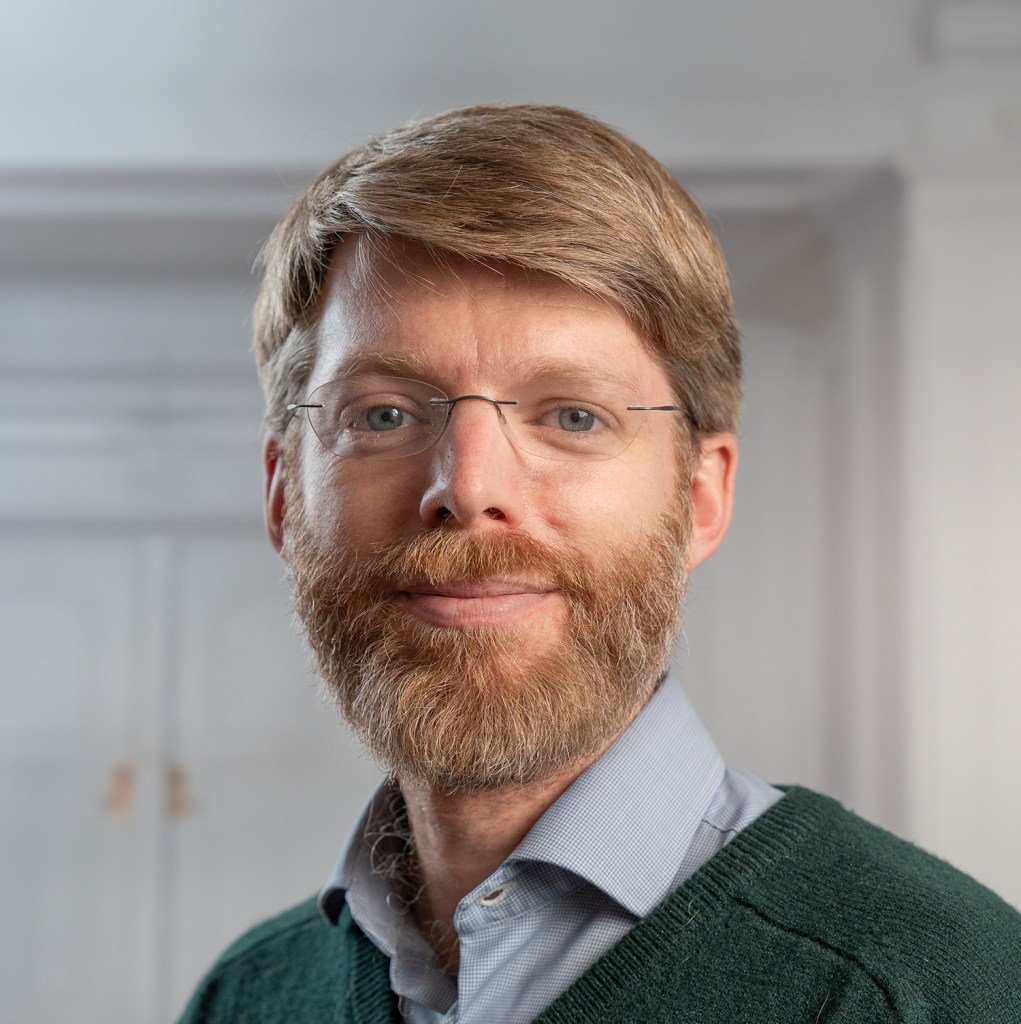
Erik Åkerlund is lecturer and director of studies at the Newman Institute in Uppsala. Erik has published on Francisco Suárez and on medieval and early modern philosophers in, among others, journals such as Vivarium and Quaestio. Together with Henrik Lagerlund and Sylvain Roudaut he has co-edited a forthcoming book titled The Mechanization of Nature: Matter, Body, and Motion in Blasius of Parma’s Physics. Currently he is working on the framework of a Swedish Research Council project titled “Nature and Norms in the 16th Century: Laws of Nature and Natural Laws” based at Stockholm University, and has worked, previously, with Henrik Lagerlund and Sylvain Roudaut on the project The Mechanization of Philosophy: 1300-1700.
The Interview
Guido Alt: Eric, thank you so much for accepting the invitation for joining us here at the IPM. It’s really a pleasure to have you.
Erik Åkerlund: Well, pleasure’s all mine.
GA: Thanks. Erik Åkerlund is lecturer and director of studies at the Newman Institute (Newmaninstitutet), and he’s going to talk to us about his research projects and his research agenda. But first, I would like to start from the beginning with your PhD, which was in this sort of crossover domain between medieval and early modern philosophy, namely it was on Suárez and the discussion of final causes, as well as the fate of this concept in the Late Medieval and Early Modern periods. So, I was wondering if you could tell us a little bit about Suárez and about final clauses in that sort of starting topic of your career.
EÅ: Sure! I can give a bit of a background. I come from a background where I was interested both in early-modern philosophy and my first mentor, so to say, at Uppsala University was Lilli Alanen, who introduced me to Descartes and other early-modern figures. And then Lilli Alanen’s pupils as well. So that was one part, and then I was interested in scholasticism. So toward my master’s thesis, I zoomed in, so to say, on Suárez. And it was actually Henrik Lagerlund’s doing, whom I now work with at Stockholm University, and who’s professor there in the history of philosophy. He was my supervisor for my master’s thesis already. So he kind of brought me to Suárez, who was then, at that time, not very much studied in the Anglophone world; this was about 20 years ago. Since then, there have been a lot of studies. For my PhD, I have chosen to work on this notion of finality, which is, of course, a very central and important concept in the, let’s say, Aristotelian tradition, broadly conceived, and one topic that is often chosen as a really distinction between, on the one hand, scholastic philosophy or Aristotelian philosophy, and on the other hand, early-modern philosophy. So my conclusion was that Suárez comes quite close to a notion of finality that we can also find in someone like Descartes. In Descartes, famously, in Descartes’ Meditations, he writes that there are ends in nature, but since we can’t know the mind of God, we can’t treat them in physics.
Also in Suárez, there are ends in nature insofar as God concurs with the action of natural agents. So in that sense, it comes quite close. And I would analyze this as what I call a “cognitivization of final causation”, which of course goes way back, and I’ve treated that in later articles as well. But it’s a very interesting, let’s say tension, within an Aristotelian philosophical tradition, especially in a monotheistic or theistic setting that you, on the one hand, have this Aristotelian notion of finality, which I take it, incorporates a rejection of finality being the external intention of a rational agent with a theistic conception where precisely finality has to do with some kind of external intention of a rational agent. So we see this really in Suárez, ends being the intention of a rational agent, when it comes to nature, that is God; in our actions it is of course ourselves. So that is both the narrow theme of my dissertation, namely final causation in Suárez and, very briefly, the broader context of that question and why that question is important.
GA: And that already goes back to the 14th-century philosophers and also to the developments in the Middle Ages of this notion. Which is also a topic that you’ve been working on in Stockholm, and even currently, but also previously in the Mechanization project, which was a project that went until 22, I think, or 23?
EÅ: From 2020 to 2022. So, so three years.
GA: Yes. You worked on that with Henrik Lagerlund and Sylvain Roudaut. I’m wondering if you can tell us about the scope of the project generally, and if you want to also connect it with finality. I was wondering if you could give us the general picture of the project?
EÅ: Sure. So the project was called Mechanization of Philosophy: 1300-1700. And the very big picture of it is it’s a project that is kind of a long-standing project internationally, and that many have worked on. Namely, it is to try to tell a more continuous story of philosophy, and especially in this case, of natural philosophy, from let’s say the mid 14th Century, that is around 1350, and up until let’s say 1600s or thereabouts. There is a kind of lack of a continuous story there. So we focused, in this project, mostly on that period.
So we talk about mechanization and mechanism, and then the first question would be what that is, and, as I said, this is natural philosophy. Mechanism and mechanistic natural philosophies can be described in a number of different ways, and that there are a number of different factors that come in there. One that is often mentioned is a kind of mathematization or quantification, within natural philosophy, of certain qualities, namely: it quantifies certain qualities, for example. There is also the inherence of accidents directly in matter. So, you start talking about what happens in the natural world, from the material aspect, just from the accidents inherent in matter and from the properties of matter. And here you can see that there’s a push toward reducing the accidents to actually what essentially goes for matter itself. But to connect to the finality part, I would also say that there is this analogy between seeing nature as analogous, or in relation to, mechanisms, that has mostly been studied in relation to artifacts; but to treat nature then, as an artifact or as one has treated artifacts. So we have actually this “scientia de ponderibus”, “science on weights”, that you have from a more Archimedean tradition, and that is treated by a person like Jordanus of Nemore in the 13th Century, that is very influential. And you kind of incorporate that, then, into a natural philosophy, so you start describing natural philosophy in terms of mechanisms. That is, well, a science of weights, and so on. And this, we argue then, is taking place much, much earlier than has often been described. Of course, there are earlier studies of this: someone like Marshall Clagett has written extensively on this tradition. But especially in the Anglophone world, it has not been treated together in this way. Here I can recommend an article by Henrik Lagerlund and Sylvain Roudaut. This represents, in a perhaps broader way, what we tried to do in this project. And more specifically, I mean, it’s not just stating that this is so, but trying to actually spell out the way it goes and to find the texts and missing links and try to work more concretely in that way, actually mapping or tracing these traditions and how they come into the 15th Century and then further into the 16th Century.
GA: Yes, and one of the outputs of the project is the recent book that’s coming out on Brill, by you, Henrik Lagerlund, Sylvain Roudaut, and also Robert Andrews who collaborated on the edition, which is a book on Blasius of Parma titled The Mechanization of Nature: Matter, Body and Motion in Blasius of Parma’s Physics. It seems that the book connects exactly to the goals of the project, insofar as it is a book about natural philosophy and a book about a figure that is sort of underexplored in that tradition. Can you tell us a little bit about the book? We’re looking forward to seeing it, by the way, pretty soon.
EÅ: Great to hear it. Yeah. I mean, I think this represents quite well what we want to do: to more concretely fill in certain gaps. So Blasius of Parma, or Biagio Pelacani, lived between 1350 and 1416, just to place him in timewise. He’s interesting in many different ways, among others in that he combines certain traditions. As I was saying, we have different traditions that don’t exist separately but that interact. So for him, coming from Italy, then studying in Paris, he combined the tradition of the Oxford calculatores (Heytesbury and Bradwardine and others) with the Parisian tradition, (Buridan, Albert of Saxony, and so on), and brought these together really, and then brought these in its turn, back to Italy. So, he represents an interesting intersection of different traditions in that sense. You can really see this in his questions on the eight books of the Physics. There are different versions, the ones that Robert has edited and worked on, has been worked on so that a selection of questions has been made, and only some are presented in the volume, which are eight of these questions, and we just have them in Latin, but we have a very extensive part at the beginning where we have introductory articles that relate to the different questions treated. So we don’t have a translation of all of these questions, but we have translations of central parts in these individual articles together with a description of it and a treatment of these parts of the Physics.
And I think that that is quite a helpful way, and other books are also done in that way. And one can just also mention that it’s especially in the Anglophone world that this is very understudied and we don’t really have much material. But there is editing work done and it’s written about this earlier in French, for example, among others by Joël Biard, who also collaborates in this volume, both with the editing of the texts and with one of the introductory articles. He’s really an expert on Blasius of Parma. I can, perhaps, also mention something that’s quite funny with these articles and that someone can perhaps work further on and see if they can get more sense of it.
So incorporated into these questions on the Physics – I mean, we have more or less standard questions in one sense, you know where to look for when he treats different topics, although he then combines different authorities and different traditions within this. But the questions are basically built up as you would expect, so he has a certain position on the question and so on. I myself worked quite a lot on rarefaction and condensation. So, you start out with objections to his view or what he wants to treat. In this example, that there would be such a thing as rarefaction and condensation. But then, he puts in – before he goes on to answer and state his own, he kind of incorporates some questions or some issues that seem just totally irrelevant. So in this case, for example, he puts in the treatment of why pregnant people get different cravings, for example, after cherries. And then he relates it to the kind of medical tradition, and then he goes on to state his view on rarefaction and condensation. And then in the end, answer the preliminary objections. So, exactly how this strange treatment would fit in with what was said earlier, it’s not really clear. There’s a hypothesis that it’s within his teaching that he kind of treats these questions simultaneously within the teaching setting, and then mentions the one and then the other. But if someone has a good answer to that, we would be most interested in that!
GA: So interesting, many open questions.
EÅ: Yes!
GA: So, of course, the project had this emphasis on continuations and telling a more continuous history of philosophy. And one challenge there is the sheer volume of material that is just unknown or not studied so much, or maybe not studied so much in some or other academic tradition. You have also written on noncanonical figures, or nonstandard figures in the history of philosophy. Of course, the period involves essentially those figures because it’s hard to categorize the intellectual environment where they belong to. One example is Javellus, for example. You’ve written about his own philosophy in connection with finality as well. So, considering these disciplinary crossovers that are even required, in that case of study, I think it would be interesting to sort of close off by taking the opportunity to ask, what do you think are sort of the directions that such crossovers can take? How do you sense the field sort of moving toward these borderlines between the periods, and what sort of orientations do you think that research on these intersections can fruitfully take?
EÅ: That’s a good, very good question. I mean, it’s hard to predict how it will go, but perhaps this is more from what I see as interesting. And then, of course, I hope that people will be interested in that also and work on that. But I think perhaps I can take it to a very concrete example. One relates to a conference I just recently attended in Leuven, which was named From modi rerum to modes of union. So it was on the conception of modes. This is one example that you have a concept or a notion, or a conception, and you try to treat them with different people who are specialized in different areas. So this was from the 13th century and up until the 17th century. And of course, you have these modes – modi rerum or modi essendi -, the modes of being that relate from the earliest times to the transcendental goodness, truth, to that which pertains to everything which is or which is real or which exists (well, that’s part of what the debate is about). And then this is transferred or transmitted throughout history and it changes in certain ways. I mean, Scotus and his followers on this question, for exampl,e have shaped the tradition. And then, I mean, you come to someone like Descartes, for whom modes play a very important role in the Physics and also with respect to the union of matter and soul. And so insofar as he has a question, that is that it is a mode. And also in someone like Spinoza, modes are extremely important because all there is, basically, is one substance. But insofar as there are individual things, they are modes of the substance. So, what is, what are these modes? And of course, you have this transformation then, within the tradition, once you come to the philosophers that we call early-modern. So that is kind of telling of the history of certain concepts, that perhaps goes towards intellectual history, and that also relates to the history of science, but that’s driven all the time by the philosophical questions and understanding of different philosophers within their contexts. That, I think, is the way forward, just as in another area where I, myself, have also worked, within political philosophy. Take something like social contract theory, described as just coming down there senkrecht von oben in the mid 17th century with someone like Hobbes and then also Locke. But of course, that’s not really how it goes. I’ve worked most extensively on Francisco Suárez, on his views on the basis for political authority. And there you also have aspects of agreement among people that they constitute together, by their shared willing, a political body. And so in this new project that we also have that’s based at Stockholm University, namely Nature and Norms: From Natural Laws to Laws of Nature. we’re looking at these kinds of questions in
John Mair, the early 16th-century philosopher, who also has this kind of understanding of political power, that it comes from a kind of consensus of a people. So, not to delve too deep into that, that’s also one area where there is a similar, more continuous story to tell. And that’s not to take away anything from philosophers like Descartes or Hobbes, it is just to understand them better. I mean, and the “proof of the pudding is in the eating”, right? So if we can try to explain this background, and that makes us understand them better, and perhaps we can then see better what main points they’re actually trying to do, then that’s achieving something. That’s what we are working with, right? We’re trying to understand the philosophers in order to engage with their thinking and their philosophical questions.
GA: Thank you so much Erik, that was fascinating, and thanks for your insights on these questions. We never had in IPM Monthly yet these kinds of questions about the crossovers and these borderlines between medieval and early modern philosophy, so it was lovely to have you.
EÅ: I’m glad that you invited me. Thank you very much.
©️Guido Alt | “Final Causes and Mechanization”, IPM Monthly 4/6 (2025).
 IPM Monthly