

Aquinas’s Legacy: A New Vision of Eudaimonia
A Lecture by Robert Pasnau
By Isabel Inzunza Gomez
On Thursday, March 7th, at the KU Leuven Institute of Philosophy, a notable gathering unfolded, marking a significant commemoration in the realms of medieval philosophy and theology. The event was dedicated to celebrating the 750th anniversary of Saint Thomas Aquinas’s passing. The “Holistic Eudaimonism Conference,” as it was aptly named, sought to unravel the intricacies of Aquinas’s efforts to harmonize the Christian philosophical tradition with the Aristotelian corpus.
At the heart of the conference stood Professor Robert Pasnau, a luminary in the field of medieval philosophy hailing from the University of Colorado. Pasnau, renowned for his extensive work on the history of philosophy, particularly during the transformative period bridging the late Middle Ages and the early modern era, embarked on an exploration of Aquinas’s attempt to rehabilitate Aristotelian eudaimonism. With a distinguished career that includes the editorship of the Cambridge History of Medieval Philosophy and numerous pivotal publications, Pasnau’s voice carried the weight of authority and the passion of a scholar deeply engaged with his subject.

The abstract of the conference set the stage for a deep dive into how Aquinas strived to elevate the concept of eudaimonism beyond the confines of mere personal happiness or a reflection of humanity’s fallen state. Instead, Aquinas envisioned a model of eudaimonism that bore its full normative weight, presenting a robust framework for understanding moral existence. This ambitious project challenged the traditional Christian emphasis on self-abnegation and the love of God and neighbor, proposing a revolutionary way to reconcile these imperatives with the pursuit of happiness.
In the conference, Professor Pasnau remarked, “Aquinas was simply my first love and just remains a persistent, I could say, obsession of mine to understand what’s really going on behind this man’s conception of eudaimonia.” This personal revelation not only humanized the intellectual pursuit but also underscored the profound impact Aquinas has had on thinkers across centuries. The professor’s analysis began with a thorough examination of the term eudaimonia, traditionally translated as ‘happiness’ but laden with deeper philosophical connotations in both the Greek and medieval Christian contexts.
Eudaimonism, as Pasnau elaborated, combines three distinct yet interconnected claims: a descriptive psychological claim about human motivation, a normative ethical claim about morally good action, and a diagnostic claim about the roots of immoral actions. This tripartite framework provided a foundation for understanding Aquinas’s innovative approach to synthesizing Aristotelian ethics with Christian theological imperatives.
Professor Pasnau’s exploration of the historical evolution of eudaimonism set the stage for a profound reevaluation of Aquinas’s philosophical project. Eudaimonism, with its roots deeply entrenched in the soil of ancient Greek philosophy, traditionally posited happiness or flourishing as the ultimate goal of human life. Aristotle, in particular, conceived of eudaimonia as a rational activity of the soul in accordance with virtue, a vision that heavily influenced the intellectual landscape of the ancient world.
The transition of this concept into the medieval Christian context, however, necessitated a significant transformation. Pasnau pointed out, “Now, in the Middle Ages…things get more complicated, and they do so largely because of the challenge of Gospel efforts because of the radically altruistic perspective. That’s built into the Gospel story about ethics,” highlighting the foundational role of Matthew:22 in shaping Christian ethical thought.
The radical call of the Gospel, encapsulated in Jesus’s command to “Love the Lord your God with all your heart and with all your soul and with all your mind. This is the first and greatest commandment. And the second is like it: Love your neighbor as yourself,” presented a profound challenge to the classical understanding of eudaimonism. This scriptural mandate underscored the primacy of selfless love and altruism, steering the discourse on eudaimonia towards a communal and other-regarding orientation.
Pasnau illuminated Augustine of Hippo’s pivotal role in this transformation, noting that Augustine “stresses the prominence in our psychology of our drive for happiness, and he never, never denies it.” Augustine’s interpretation of eudaimonia transcended the pursuit of earthly pleasures, advocating for a life oriented towards God as the true source of fulfillment. This articulation seamlessly integrates this descriptive claim with a coherent normative stance, suggesting that the pursuit of happiness, when rightly directed towards God, aligns with moral goodness. However, Augustine rejects the diagnostic claim as he observes a disjunction between what one ought to do—pursue happiness in the divine—and what one actually does, underscored by humanity’s fallen state. This gap, for Augustine, cannot be bridged by mere human reason or will; instead, it necessitates divine grace.
Pasnau then delved into Anselm of Canterbury’s contribution to this discourse and further complicated the picture. Anselm introduced the concept of two affections of the will: one towards personal advantage and another towards rectitude or justice. Pasnau elaborated on Anselm’s perspective, stating, “Anselm explicitly makes the case that if all of your motivation is toward happiness, you in fact won’t achieve justice, you in fact won’t achieve a morally good life.” With this assertion, Anselm effectively challenges the normative claim of eudaimonism, which posits morally good action as arising from the rational pursuit of one’s own happiness. His introduction of the affection for justice as a distinct and potentially competing motivational force suggests that true morality may require sacrifices that do not directly contribute to one’s own happiness. This stance puts an end to the classical doctrine of eudaimonism in its traditional form, introducing a nuanced understanding that moral actions might stem from motivations beyond the pursuit of personal happiness.
Aquinas, as Pasnau elucidated, diverged sharply from this perspective. He did not dismiss the pursuit of eudaimonia as a mere consequence of humanity’s fallen nature; rather, he integrated it into the fabric of moral existence. Aquinas reimagined eudaimonism within a Christian framework, suggesting that the true pursuit of happiness was not only compatible with Christian ethics but was indeed essential to it. This reinterpretation was not a mere synthesis but a radical reconceptualization that preserved the core tenets of Aristotelian eudaimonism while infusing them with a distinctly Christian spirit.
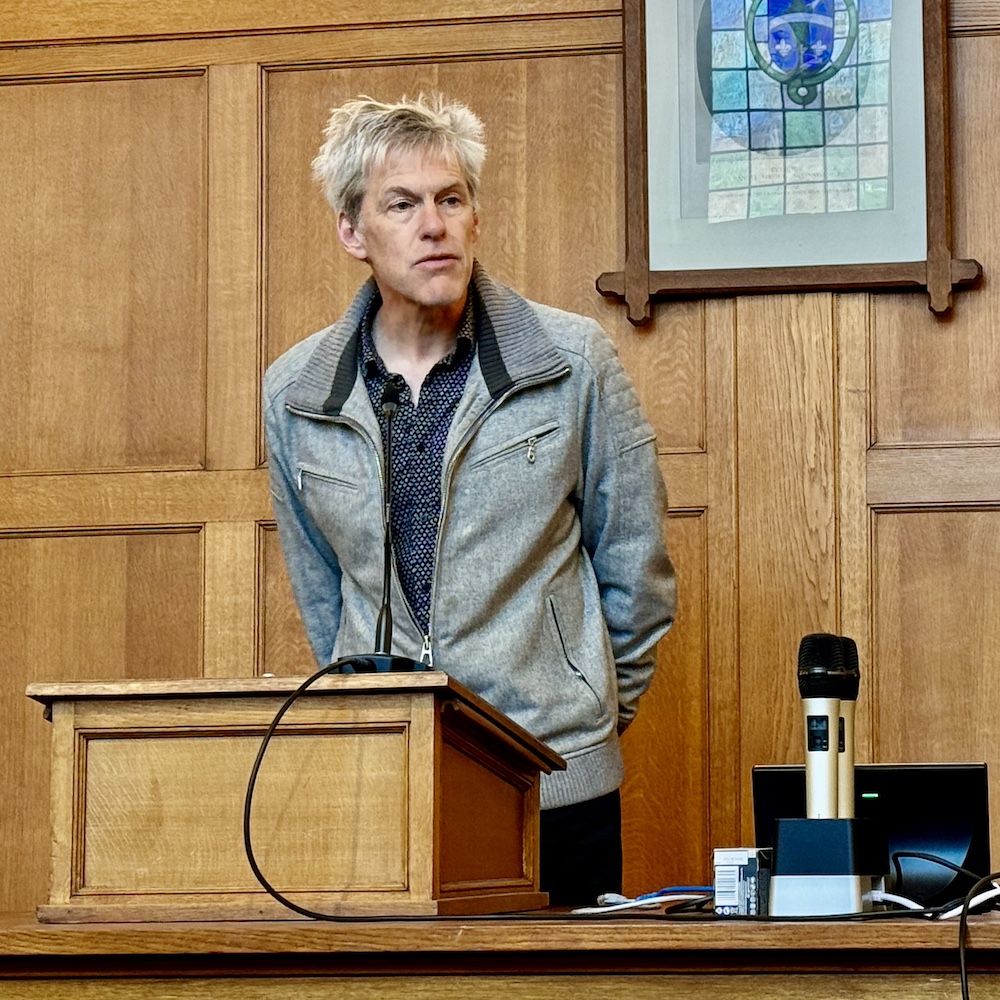
“What’s so interesting about Aquinas’s way forward,” Pasnau remarked, “is that he thinks you can have all of the virtues that the ancient eudaimonists thought their theory had, and you can have it in a Christian context.” This statement captures the crux of Aquinas’s philosophical innovation. He envisioned a model of eudaimonism that upheld the classical virtues—wisdom, courage, temperance, and justice—as pathways to human flourishing, yet he rooted these virtues within the broader theological narrative of Christian salvation. For Aquinas, the ultimate end of human existence was not merely personal happiness but happiness achieved through the alignment of one’s life with divine will and the communal good.
Pasnau’s discourse reached a crescendo as he delved into Aquinas’s holistic reinterpretation of eudaimonia. This was not limited to individual well-being but extended to the flourishing of the entire cosmos, a notion deeply rooted in the interconnectedness of all creation. Pasnau quoted Aquinas, emphasizing the natural inclination towards happiness as the ultimate end and the moral imperative to align this pursuit with the broader, communal good. “In actions subject to practical reason”, Pasnau quoted, “the first principle is the ultimate end. But the ultimate end of human life is happiness […]. Therefore the law must respect, above all else, the order that is in happiness. But since every part is ordered to the whole as the incomplete to the complete, and one human being is part of a complete community, it is necessary for the law properly to respect the order to common happiness” (Summa theol. 1a2ae 90.2c).
This innovative approach, Pasnau argued, allowed Aquinas to offer a compelling answer to one of the most pressing philosophical questions of his time: how to reconcile the seemingly disparate aims of personal fulfillment and the selfless love commanded by the Gospel. By expanding the concept of eudaimonia to encompass the love of God and neighbor, Aquinas bridged the gap between ancient philosophy and Christian theology. His holistic view of eudaimonism thus served as a testament to the possibility of achieving moral excellence, justice, and true happiness within the confines of earthly existence, guided by the light of faith and reason. This nuanced approach confirms the interwoven nature of Aquinas’s eudaimonism, wherein each claim—descriptive, normative, and diagnostic—finds its fulfillment, illustrating a seamless synthesis of Aristotelian ethics with Christian virtues.
The audience’s engagement was palpable, culminating in a question-and-answer session that explored the relevance of Aquinas’s holistic ethics in the modern world. Pasnau confronted the challenge of reconciling these medieval ideals with contemporary ethical frameworks, acknowledging the complexity of integrating a cosmic theological vision into a largely secular moral discourse. He suggested that while the pursuit of a holistic approach to ethics might seem daunting in a non-theistic context, the core principles of Aquinas’s thought—focusing on the common good and the interdependence of all beings—offer a valuable perspective for navigating the ethical dilemmas of the modern age.
The “Holistic Eudaimonism Conference” was nothing short of illuminating. This event was not only a fitting tribute to one of the most influential figures in medieval philosophy but also a vibrant demonstration of philosophy’s enduring vitality and relevance. Celebrating Aquinas in such a thoughtful and engaging manner underscored the timeless nature of his work and its continuing capacity to inspire and challenge us, proving once more that philosophy, much like the legacy of Aquinas himself, remains a lively and crucial part of our intellectual and moral landscape today.
©️Isabel Inzunza Gomez | “A New Vision of Eudaimonia“, IPM Monthly 3/3 (2024).
 IPM Monthly