

Unveiling the Controversial: An Interview with Pierre Vesperini on the Cancel Culture Phenomenon
by Sarah Virgi
Summer 2023 – In a world dominated by rapidly evolving social dynamics and a quest for justice, one topic has sparked intense debate and polarized opinions: cancel culture. To shed light on this contentious issue, we sat down with Pierre Vesperini, esteemed author of the thought-provoking book, Que faire du passé ? Réflexions sur la cancel culture (“What to Do with the Past? Reflections on Cancel Culture“).
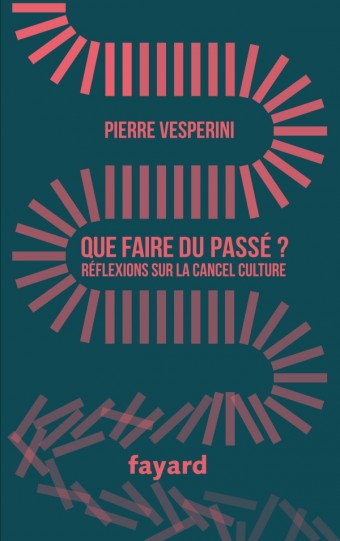
Cancel culture, a term that has gained prominence in recent years, refers to the act of withdrawing support or public acknowledgment from individuals or institutions deemed to have committed offensive or inappropriate acts. It often involves public shaming, boycotts, or social media campaigns aimed at silencing or ostracizing those under scrutiny. Furthermore, cancel culture has extended its reach into the realm of academia, impacting especially the domain of Classics. Notably, Dan-el Padilla Peralta’s case stands out, as he boldly proclaimed that Classics departments should be eradicated from universities given that the discipline had been instrumental in the imposition of white domination and oppression of black people, thus igniting a fervent debate about the place of these departments in contemporary education.
Vesperini’s fascination with cancel culture emerged from his unwavering interest in the challenges facing our world today, as he tells us in this interview. According to him, cancel culture predominantly affects American society, although it is also felt in some European countries, such as France, with a lesser impact and significance. Drawing from history, particularly America’s painful past intertwined with slavery and racism, he emphasizes how these historical wounds have shaped the nation’s collective consciousness, making it particularly susceptible to cancel culture’s impact.
While acknowledging the potentially unsettling and violent nature of certain texts, however, Vesperini firmly believes that no book should be erased from the philosophical or literary canon. He argues that it is essential that we, as human beings, should confront our shadows in order to address our societal issues and gain deeper insights into ourselves. In support of his stance, he invokes the words of Carl Gustav Jung, who emphasized the significance of acknowledging and integrating these facets for personal growth and collective progress.
Vesperini advocates for expanding the literary canon to include other works that tackle pressing topics such as post-colonialism and feminism. As society evolves, so too should our understanding of the canon. By incorporating diverse perspectives and narratives, we open up new avenues for learning and reflection, fostering a more inclusive and nuanced understanding of the world.
Throughout this interview, Vesperini invites listeners to question the boundaries of cancel culture, its impact on different societies, and the importance of preserving a diverse and comprehensive literary canon. His thought-provoking insights challenge us to grapple with the complexities of our past, encouraging us to embrace uncomfortable truths and confront our collective shadows.
About Pierre Vesperini

Pierre Vesperini is a historian and philosopher, specializing in Greek and Latin Antiquity. He is a researcher at the CNRS (Centre national de la recherche scientifique) and holds a doctoral degree in History and Semiology of Text and Image (Paris-VII – Denis Diderot, 2010). He authored several monographs on the history of ancient philosophy and literature, such as: La philosophia et ses pratiques d’Ennius à Cicéron (2012), Droiture et mélancholie. Sur les écrits de Marc Aurèle (2016), Usages romains des savoirs grecs sous la République et sous l’Empire (2016). In 2017, the Académie Française awarded him the “Prix La Bruyère” for his work Droiture et mélancholie, and in 2022, he earned the “Prix Georges-Dumézil” for his edition and translation Théocrite. Les Magiciennes et autres idyles (2022). Vesperini also contributes regularly to the French magazine Philosophie Magazine, where he published several articles on topics relevant to the present day.
 IPM Monthly