

My Dinner with Camila Lobo: An Interview
by Maria Luís Pinho
In the January issue, IPM presents an interview with Camila Lobo, PhD student and researcher at the Faculty of Social Sciences and Humanities of Universidade Nova de Lisboa. She is currently developing an FCT-funded doctoral project on care and social standpoints. Her work combines different areas of interest: from social epistemology to feminist theory, philosophy of language and Wittgenstein’s philosophy.
About Camila Lobo
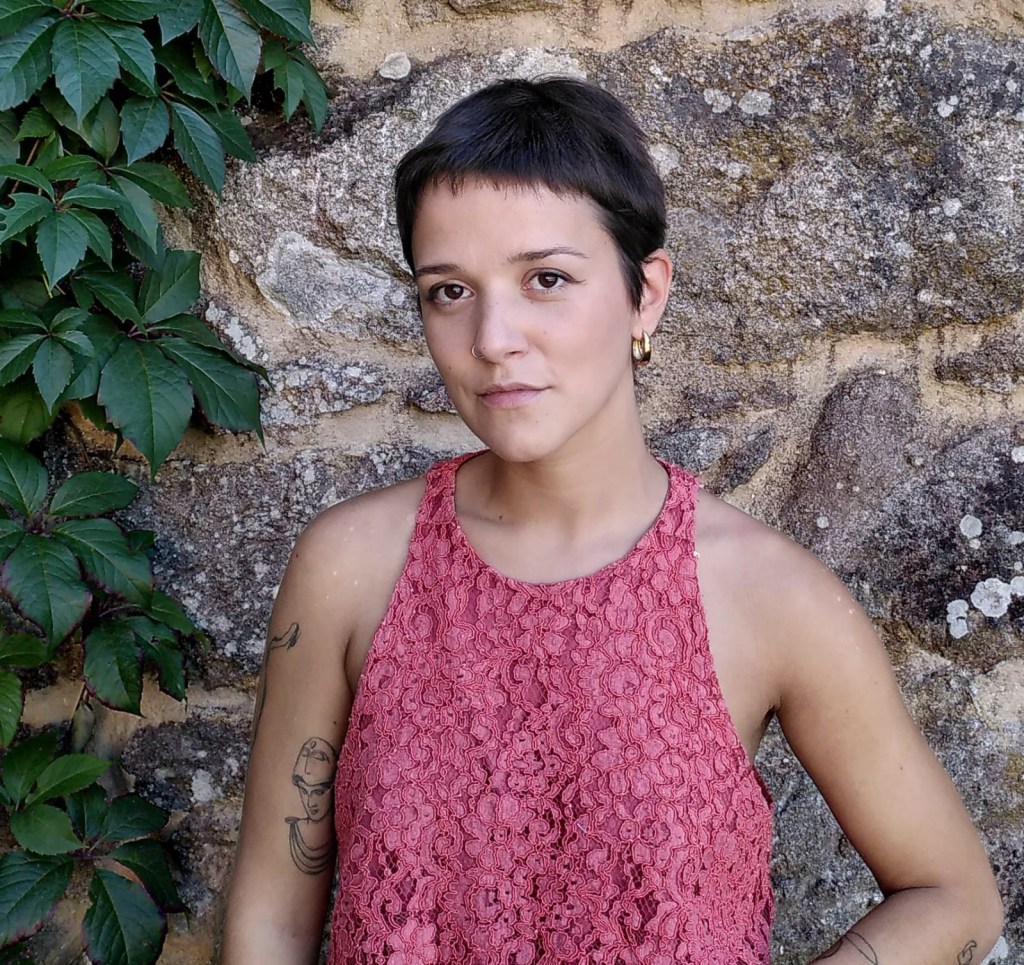
Camila Lobo is a PhD student in Philosophy at the Faculty of Social Sciences and Humanities of Nova University of Lisbon. In 2016, she graduated in Philosophy from the Faculty of Arts and Humanities of the University of Porto and, in 2019, she was awarded a master’s degree in Philosophy with a specialization in Political Philosophy by the Faculty of Social and Human Sciences of the New University of Lisbon, where she defended her dissertation “Inessential Woman, but Woman: Feminism, Wittgenstein and the Problem of Difference” under the guidance of Professor Nuno Venturinha. She is currently developing an FCT-funded doctoral project on care and social standpoints. Her work combines different areas of interest: from social epistemology to feminist theory, philosophy of language and Wittgensteinian philosophy.
The Interview
Maria Pinho: Firstly, I’d like to ask you how you ended up studying your research topic. What path, with all its luck and challenges, led you to it?
Camila Lobo: I don’t think I’m far from the truth if I say that, for the whole duration of my undergraduate studies, philosophy was something that sat quite outside the realm of my personal life and the social world as I perceived it. Reading Augustine, Descartes or Kant spoke most intimately and directly to what I regarded as my private life and long-standing philosophical anxieties. So, by the time I got politicized, philosophy wasn’t exactly the place I turned to for answers. It remained, to a certain extent, the abstract sphere of pure thought where things could happen apart from the constraints of real life. Of course, as those practical “constraints” became increasingly central in my life – that is, as issues of inequality, exploitation and oppression took over my mind and social sphere – philosophy no longer looked like a viable path to follow. So, I took a year off and worked for an NGO, read about politics, and started doing some community work.
But even as I enrolled in a master’s program in political philosophy, a year later, the connection between theory and practice wasn’t immediately clear to me. I did, however, become obsessed with Wittgenstein at that time. There was something about his work that was, in a sense, profoundly anti-philosophical – from his early suggestion that philosophers had little to say about the most daunting existential questions of human life to his later commitment to begin his investigations from the “rough ground” of ordinary practices.
By that time, I was doing a lot of activist work, organizing with feminist collectives. The new internationalist feminist movement, with its roots in Latin America, was bringing care work back to the center of the conversation, combatively pushing for a redefinition of work outside the boundaries of the wage system, creating alliances with other social and working-class movements. We were reading Federici and promising each other a care revolution! So, for me, whether philosophy could do something that spoke to this commitment was a deal-breaker. I seem to have found out it could.
MP: Your research focuses on women and care. Do you think this subject is always dependent on an analysis within the scope of feminist theory?
The extent to which my current research focuses specifically on women is still pretty much a topic of debate for me. Contrary to what I did for my master’s dissertation, in which I focused on debates around the category of “woman”, my doctoral research is concerned with caregivers, specifically with the kind of knowledge that may be derived from the social locations they inhabit. And by that I mean not simply the immediate content of that knowledge – which requires us to operate with a knowing how / knowing that distinction to the extent that a person who consistently performs care work may, for instance, be exceptionally capacitated to attend to other people’s needs while simultaneously prevented from accessing public forms of knowledge production –, but also the sort of reflective political understanding their social location might position them to acquire – for instance, coming to see the connections between care work, gender violence, racialized poverty and the capitalist wage system.
Although the latter is a point I take mainly from feminist standpoint theory, it is not, in any way, applicable to women alone. Standpoint theory’s main argumentative line involves a kind of inversion thesis whereby otherwise marginalized individuals or groups may, in fact, hold an advantage when it comes to making sense of their social experiences under conditions of systemic oppression. This epistemic privilege thesis is contentious in many ways, and this might not be the context for me to try and defend it, but let me stress that it should in no way be taken to imply either an essentialist conception of group standpoints or an automatic privilege thesis. A standpoint is not something one immediately has access to by virtue of inhabiting a marginalized social location, but requires collective philosophical and political struggle. And this should hold for marginalized subjects across different contexts.
Don’t get me wrong, women have everywhere, in virtually every epoch, been assigned the role of primary caregivers in and beyond the household. This is not to say that men have not or cannot perform care duties – it is to say that people who are socialized as women are collectively assigned that role, whether they abide by it or not. I am one hundred per cent taking for granted the case made by radical feminists that the naturalization of women’s labors in the home has centrally contributed to their oppression in society at large, as well as that of Marxist and social reproduction theorists who powerfully argue that those labors are essential to the maintenance of a capitalist social formation. I am furthermore taking for granted that this femininization of care work extends well beyond the domestic sphere and is reflected in both increasingly precarious, racialized waged work – that of housemaids, cleaners, educators, etc. – and the forms of affective labor that are involved in our intimate relationships and broader community bonds.
My doctoral project is an attempt to trace the conceptual connections between these very objective understandings of social reality and the subjective perspectives of those who perform care work under conditions of marginalization or oppression. So, you see this is an investigation that need not be circumscribed to the territory of feminist theory and can indeed expand in a lot of different directions to address wider social and philosophical issues. But I don’t think it is a coincidence that feminist theorists have been at the forefront of both political conversations about care and philosophical discussions about situated knowledge. They’re not simply issues that speak closely to women, but deeply entangled questions – how could we come to see these forms of invisibilized work and understand the forces that shape them if we weren’t invested in problematizing dominant epistemological conceptions and seeking out alternative ones? In that sense, it is difficult to imagine these having become relevant topics of social criticism were it not for feminist theorists.
MP: What other theories and concepts, philosophical or otherwise, do you think could shed light on this subject?
I think it’s important to recognize that there are indeed different points of entry here. Although, as I said earlier, I am taking some of the insights of social reproduction theory and Marxist feminism as the starting point for the kind of inquiry I want to engage in, my current project is not a direct contribution to that field. Another tradition that I inevitably draw from when speaking about care is that of care ethics which, no matter its well-known limitations, has been responsible for opening up a terrain in moral philosophy where individuals are conceived as inherently relational, interdependent and vulnerable, and has thus problematized traditional conceptions of the moral agent as an ideally neutral and detached subject. These traditions give me a baseline to pose the questions I am interested in: how does one come to see certain aspects of the world under ideological systems or conditions of oppression? How does one come to speak about them from marginalized social positions? And how do we come to integrate that knowledge into our lives in the face of a social order that is eminently hostile to it? To answer those questions, however, I must turn to epistemology and philosophy of perception.
I mentioned standpoint theory and its commitment to the idea that an objective understanding of the world demands we begin our investigations from the lived experiences and perspectives of marginalized people. The idea of situated knowledge has of course gained traction far beyond academia and philosophical circles – it is currently widely employed in social work and educational settings, for instance –, but standpoint theorists take things a bit further. They’re not simply saying that attending to the experiences of the marginalized is important if we want to have a more complete picture of the world – they’re claiming that completeness is not something to aspire to if it implies an aspiration to neutrality. That truly engaging with marginalized perspectives might profoundly change the way we perceive the world.
Although standpoint theory is directly inheriting from Marx and, particularly, from Lukács, according to whom the knowledge yielded from the standpoint of the proletariat stands on a higher objective plane than that of bourgeois thinkers, this idea can be independently found in other radical social theorists. The work of bell hooks immediately comes to mind. Her conception of marginality not merely as a site of dispossession, but as a space of resistance – in the sense that the marginalized, by literally being forced to move from center to margin on a daily basis, acquire an oppositional view that is not equally accessible to dominant subjects – remains one of the most powerful takes on this matter.
I think you can also find a very similar idea in Wittgenstein-inspired philosophies. The idea, that is, that certain aspects of the world can only come into view from specific non-neutral perspectives. As I suggested earlier, Wittgenstein’s philosophy was the first canonic work where I found important similarities with the kind of political, particularly feminist, theory I was engaging with. To quote Naomi Scheman freely: “What Wittgenstein and feminist theorists have in common is a deep suspicion towards the grand and important questions of philosophical modernity. They ask in unison: Why these questions? These methods?” Besides siding with feminists in questioning the purported neutrality of said questions and methods, Wittgenstein equips us with resources for understanding the philosophical roots of our “captivity” to traditional conceptions of, say, language and rationality.
Ordinary language philosophy remains my preferred playground – which is to say, it is the language I feel most at home. Its method of guiding us through examples, analogies and different ordinary uses of words in order to “get us to see” what has always been before our eyes continues to strike me as one of the most powerful philosophical approaches out there. From Wittgenstein himself to Cavell, Diamond, McDowell or Crary (in Portugal, I think you find important interventions in the work of Nuno Venturinha and Sofia Miguens), I think there are good reasons to regard ordinary language philosophers as allies of liberatory political projects.
MP: The need to create protections for informal caregivers is a relatively recent discussion in Portuguese politics, but one that is gradually receiving more attention (even if not yet enough). How do you think philosophy, and the academic community at large, can contribute to these and other social and political debates?
That’s a great question and one that philosophers, and academics in general, often forget to ask themselves. When it comes to philosophy, I don’t have a straightforward answer to give you because I think it hinges on what our conception of philosophy looks like – and, as you know, there are many ways of conceiving philosophical work. But I think I’ve been giving you some hints about my own, still developing, view. I’ve increasingly come to regard philosophy as a work of what Nikolas Kompridis calls reflective world disclosure, understood as the attempt to clarify the conditions of intelligibility of our world, which is a practice that brings together philosophical traditions and methods as distinct as immanent critique, historical ontologies and ordinary language philosophy. Conceived this way, philosophy is not merely “therapeutic” in the quietist sense that is often (wrongly) attributed to Wittgenstein, but may effectively produce a reorientation of our modes of thinking and perceiving the world.
I cannot tell you, but you certainly have had this experience yourself, how world-revealing it was for me to read certain authors that either spoke to my previously held intuitions or straightforwardly challenged my inherited worldview. This goes for both canonic philosophers, but also very specifically for the feminist theorists who introduced me to all the intersecting problems around care – many of whom are the ones informing public debate and policies on the matter! I don’t have to convince you that theory plays a crucial role in social transformation. It is, however, harder to assess the role of the academy in that transformation. Internal problems of access, affordability, elitism, precarity and inclusiveness, to name only but a few, should be addressed if we are to create an academic community that is capacitated to engage with the social world and play a role in the public sphere. In a more general sense, I am absolutely committed to the idea that philosophy and social criticism should spill over the walls of the university. We need critical pedagogies at all levels of education and rigorous intellectual engagement with public affairs.
MP: In 2023, you were at the New School for Social Research in New York as a Visiting Scholar. What was that experience like? What were the most rewarding aspects, and which were the most difficult to manage?
The New School is simply one of the most socially engaged higher education institutions in the world. You can see how that appeals to me. I was given the unique opportunity to engage with some of the most brilliant minds I’ve ever encountered, working on topics that are very dear to me and that speak to some of the most urgent problems of our times. All the while critically and thoroughly engaging with our shared philosophical and theoretical traditions. There are also well-known problems in the US educational and academic system, from which the New School is not exempt, but I’ve been deeply inspired by the resilience of both my peers and professors to remain committed to the school’s historical progressive values and legacy of radical social criticism.
MP: As far as research is concerned, what are your future plans?
I hate to disappoint you, but I don’t have much to tell you about this right now. My current priority is responding to present commitments. [Laughs] I’m entering my final year as an FCT scholar, so I’ll be fully focusing on the writing part of my research project. If everything goes according to plan, by the end of 2024, I’ll have a dissertation worth submitting, even if I already anticipate a certain feeling of dissatisfaction associated with the inevitability of leaving some inquiry paths unexplored. Hopefully I can remedy that at the postdoc level, but as of now, I don’t have concrete plans in that regard.
MP: I know you are a poetry, literature, and film lover as well. Can you tell us what is, for you, the most striking and moving art piece on care as it relates to women and work?
That’s a tough one. Once again, I don’t think I can give you a straightforward answer. I’m tempted to tell you about Adrienne Rich and Audre Lorde’s poetry, inseparable from their essays and poetic prose, their incisive criticism of racist patriarchal systems, and their caring lyrical offerings of hope. But I could also tell you about Chantal Akerman’s films, particularly Jeanne Dielman and the way it painfully drags us through its protagonist’s methodical performance of housework, making us keenly aware of the passage of time and thus deromanticizing care. I don’t think it would be too much of a stretch to speak of one of my all-time favorite novels, Virginia Woolf’s To the Lighthouse and its obsession with perception, namely the kind of vantage points that reveal the figure of the Victorian “angel of the house” that grounds and caters to the lives of everyone around her. Perception is key: these authors are brought together by their commitment to render visible the invisible.
It’s impossible for me not to mention the work of the three Marias. It is not by chance that texts such as the New Portuguese Letters and Revolution and Women became landmarks of the Portuguese feminist movement. They denounced the invisibilization of care work at the very core of the revolutionary movement and brought the ordinary to the forefront: “They went on sit-down strikes. They fought at home to go to the union and the council. They shouted at the neighbor that she was a fascist. They knew how to say equal pay and nurseries and canteens. (…) They are the ones who wake up the beasts, the men and the sleeping children in the morning.” Everywhere, it seems, the personal has always been political.
©️Maria Luís Pinho | “My Dinner with Camila Lobo: An Interview”, IPM Monthly 3/1 (2024).
 IPM Monthly