

Late-Antique Athens Through Stones and Interdisciplinarity
An interview with Ivan Mileković
By Aleksandar Anđelović
Among many student initiatives between the University of Vienna and Central European University in the area of philosophy, art history, philology, and history in general, I met Ivan, an art historian originally from Serbia. His interests in architecture, art, and archaeology on one hand and mine in philosophy, philology, and theology on the other sparked numerous discussions in a truly interdisciplinary manner. For this occasion, in vernal Vienna, I am interested in Ivan’s view on philosophy, especially considering his research regarding Neoplatonists, from the perspective of history of art and archaeology and how philosophy is intertwined with and expressed in art and material aesthetics.
About Ivan Mileković
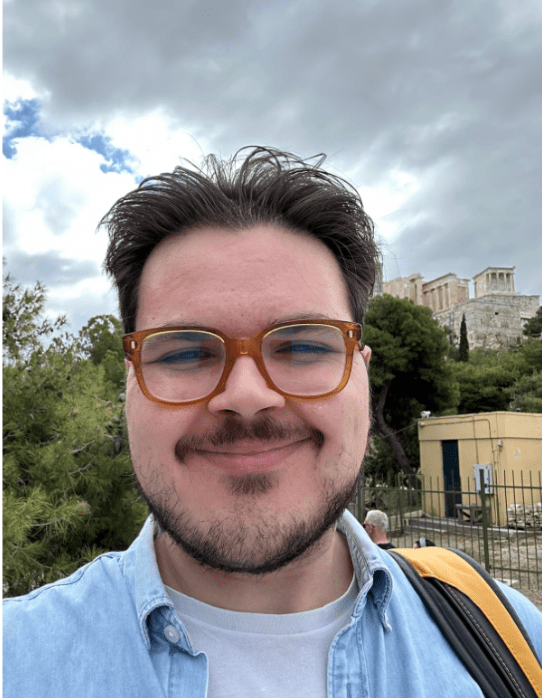
Ivan Mileković is a historian of late-antique art and architecture. Although primarily working with material sources, his interest lies in the intersection of art, architecture and ideas in the period from the second to the sixth century. In his previous work, he concentrated on Second Sophistic, and now he is dealing with the material environment of the fifth-century Athenian Neoplatonists. Aside from this, he is interested in Neoplatonic and early Christian aesthetics.
The Interview
Aleksandar Anđelović: For the start, could you familiarize our readers with the period you focus on, i. e. the period from the second to the sixth century? There are many views on this period, such as the end of antiquity and the time of the rise of Christianity as a state religion, the main label of Late Antiquity being a “transitional period.” What is your take on Late Antiquity in chronological terms and what has attracted you to exactly this period for your research and not to some other?
Ivan Mileković: I think that the material which I study, and that is first and foremost the Greek world, clearly shows that the “end of antiquity” is not something one can clearly define. Let’s focus on Athens. In the second century, Athens was a bustling town, favored by emperors such as Hadrian and Marcus Aurelius. In this sense, it was truly the seat of the intellectual movement known as the Second Sophistic. By the sixth century, Athens was certainly not politically or economically important as it was in the second century, but this does not mean there was some sort of dissipation, nor does this mean there were no changes. Of course, there were some very important religious, cultural, intellectual and socio-economical changes, both throughout the Roman empire and particularly in Athens. In terms of material and visual culture, we can see an exceptional mix of old and new. This is how I see Late Antiquity. A period of magnificent developments and changes, and not as a period of transition (in a negative sense) and decadence. It is very hard to draw a line between the end of antiquity and the beginning of the Middle Ages, and neither do I think we should draw such lines. In the words of Jacques le Goff – it is hard to cut history into pieces.
AA: You have just returned from a research stay in Athens, right? It seems to me that fifth-century CE Athens, which is your current research, is far less explored and stays in the shadow of, say, fifth-century BC Athens, because of the latter’s fame as the “cradle of democracy” and its philosophers. Would you agree and what are your latest discoveries on late-antique Athens?
IM: Everytime I tell someone that I deal with fifth century Athens (and may I note, I usually circulate in the circles of late-antique and Byzantine studies), the reaction is “Oh, fifth century BC?”. I think this is genuinely a problem with Hellenic studies, namely that there is not enough space for the post-Classical. If you go to the National Archaeological Museum in Athens, antiquity ends with the third century CE. If you go to the Athenian Christian and Byzantine Museum, Byzantine Athens (or Greece, for that matter) starts with post-Iconoclasm (second half of the ninth century), with a few references to the genesis of Christianity in Greece. I therefore definitely agree that the fifth century CE is in the shadow of the Classical past. In terms of archaeology, this has been reflected in the earliest excavations, which destroyed all subsequent layers in order to reach the classical ones. Thankfully, the excavators had detailed notes and reports, so we may reconstruct the later layers. As for my research trip to Athens, I focused on the architecture of educational institutions in the early fifth century. One of most important realizations I had while in Athens is that in the aftermath of the Siege of Alaric in 391 CE, the Ilyrian prefect Herculius, sometime between 408-410 AD, renovated the two most important educational institutions in Athens, namely the Library of Hadrian and the Odeion of Agrippa (also known as The Palace of the Giants). He also built a portico connecting the two spaces, thus creating a new urban center concentrated on the educational institutions. What is striking, moreover, is that this rebuilding project is connected to the Neoplatonists, as Plutarch, the Diadoch of the Academy, set up an honorary statue for Herculius on the entrance to the Library of Hadrian, commending Herculius for his project. In other words, this inscription attests to the relationship between the Neoplatonist and the provincial government, as well as the importance of Neoplatonists in the life of the fifth century city.
AA: Speaking of philosophy, Neoplatonists are an unavoidable part of your research. Who were the Athenian Neoplatonists in the fifth century AD, what were their religious or any other practices, and why are they important for the history of philosophy?
IM: Somewhat contrary to the popular view, Neoplatonism is not a unified philosophical school. If I may say so, it is rather an umbrella term uniting different traditions of late-antique platonisms. In the case of Athens, the Iamblichan tradition prevailed, that is, aside from interpretations of Plato and Aristotle, they focused on attaining theurgic virtues. For Iamblichan Neoplatonists, the final point of their philosophical inquiry was through theurgy, a set of rituals which would connect the soul of a philosopher with the divine. Before being able to practice theurgy, however, the neoplatonists had to acquire the political, theoretical and purifying virtues. In other words, they had to master a certain curriculum, participate in traditional forms of piety, both public and private, and only then could they go unto practicing theurgy. Yet, I am not studying theurgy, as this is a well studied subject, and I think that the best introduction was written by Ilinca Tanaseanu Döbler. There were, however, different non-theurgical rites which Neoplatonists practiced. From a form of initiation which strikingly resembles baptism to celebration of Plato’s and Aristotle’s birthdays and to veneration of Attic heroes, including the intellectual heroes embodied in philosophers! Lastly, who were these people? Most of them were pagans, but some were also Christians coming from different parts of the eastern Mediterranean, as Damascius, the last Diadoch of the Academy, informs us in his Philosophical History. Some of them were indeed Atheninans by birth, such as Plutarch, but the others were not, still all of them considered themselves citizens of Athens. The sources are quite clear that they not only participated in the social and political life of the city, but also had a very high regard for its symbolic significance.
AA: In one of our conversations you mentioned to me that one of the questions you are tackling in your research is how the Neoplatonists lived and worked side by side with Christians in fifth-century Athens. So, how and in what direction has the philosophical landscape of Athens changed from the second to the sixth century?
IM: If you read some previous scholarship on late-antique Athens, then you would find information that there were no Christians in the city before the middle of the sixth century CE, that is, after the closure of the Academy by Justinian in 529. But we know, for example, from the Acts of the Apostles that Paul held a sermon on the Areopagus. Christians actually were present in Athens since the first century, yet, unfortunately, scholarship has given almost no attention to the Athenian christian community of this period. What we are much better acquainted with is the place of Christian students in the intellectual landscape of Athens. In the fourth century, Athens was bustling with Christian students, two of them being the Cappadocian fathers Gregory Nazianzen and Basil the Great. Aside from the fact that they were as much intellectuals as some contemporary pagans, like Libanios or Julian (the Apostate), they left us quite a few information on the Christian perspective of student life in late-antique Athens. From Gregory’s Funeral Oration to Basil we know that the Christians held high regard for the city and especially for its pagan past. One interesting example is the Christian attitude towards the statue of Athena Parthenos, which they regarded as ornamenta civicum, even when the Parthenon was still an active temple. I look forward to exploring this topic further at the upcoming Oxford patristics conference! Returning to the pagans, of course, the sources of pagan provenance tell us how the Christians were always bothering them, but I find this hard to believe. There is really no evidence for direct conflict between the two groups. If the conflict existed, it was purely intellectual, and this is what I find even more interesting. The currents of the fifth-century Athenian neoplatonism were highly influenced by Christianity, as a pagan theological response to the Christian thought. Due to my academic background, I do not wish to rush into conclusions, but I wouldn’t be so sure to call later Christian thought as christianized neoplatonism. Rather, neoplatonism had as many elements of Christianity as Christian theology had elements of Neoplatonism.
AA: Is this change visible in material heritage? How do you trace the changes in, for example, architecture, urban topography, and aesthetics? Can the exploration of, for example, the locations of a certain school and/or a church in a major way change our understanding of the period in terms of philosophical dynamics?
IM: The material environment does, indeed, show much insight into the dynamics of pagan-Christian relations in Athens. Likewise, I do not believe that we can truly understand the world of Neoplatonists without understanding the spaces in which they lived and worked, as well as the spaces which they imagined. For example, Alison Frantz, the pioneer (and to this day one of few scholars) of late-antique Athens, claimed that the Neoplatonists were like a freemason lodge in the post-World War II Communist world. They were the most educated and the richest, but they had to hide in their homes from the oppression of the state. As such, she claimed that all forms of philosophical teaching in late antique Athens took place in the houses. But a mere glimpse into the material evidence makes this thesis implausible. As I previously said, a new urban center of the fifth century city was created by the state authority, and it was concentrated around educational institutions. Who else could have inhabited such institutions, if not the Neoplatonists?
AA: Recently we discussed a Roman inscription from the first century AD in Greek found in the walls of one mosque, whereby I read and interpreted the inscription itself while you speculated on its usage on a mosque and the wider implications of such a usage, including the history of the inscription and its status in the local area, making the discussion an interdisciplinary endeavor. ‘Interdisciplinarity’ is nowadays often used as one of many catchy phrases, often meaning next to nothing. Do you believe that ‘interdisciplinarity’ can soon get its deserved place resulting in fertile discoveries apart from its overuse in academic conferences?
IM: This is a grand question. I think that interdisciplinarity is an exciting concept, and can really offer us a lot of new insight. However, being interdisciplinary is awfully difficult. How much training do you need? Can one person really use the full potential of different disciplines? Of course, I think that leaving the strict boundaries of your own discipline is very important. I also think that caring, reading and inquiring into other fields is crucial, but I am not very optimistic that we will have true interdisciplinarity as mainstream anytime soon.
AA: How do you see modern academia in art history, architecture, and archaeology? What can be improved and have, for example, modern technologies such as digital humanities massively changed your research area?
IM: Well, I think that modern art history has two main currents. The, let’s call it European one, mostly German, which is very source based, understanding the broader context in which art and architecture developed. The second one, let’s call it American, seems a bit more anthropological to me, in that it focuses on interpretations of such concepts as sexuality, race and gender through the prism of visual culture. Although both offer interesting results, I myself am much more inclined to the so-called German current – I am interested in contextual development of art and architecture, and especially in its connection to intellectual culture and social history. One of the newer approaches to scholarship, that I am very fond of, is the so-called “response iconology”. In other words, I try to understand how different people respond to the art that I study. This does not entail only the intellectual response through text, but also the “material” response. For example, inscribing a cross on the forehead of a statue can tell you a lot about the christianization of such statues and about the people who appropriated it. Development of archaeology, on the other hand, is somewhat different. I can only speak about those aspects of classical archaeology which concentrate on art and architecture. As far as the digital revolution goes, art history and archaeology have surely been integrating digital methods since the early 1990s. Although the recent emergence of digital humanities did find its way in art history, I am not sure if there has been any revolutionary change to the field at this point. However, older approaches which entail usage of digital methodology have been significant in the last three decades.
AA: You are currently based and study in Vienna, probably the most important research center for the history of art and where the term Spätantike was used for the first time. How do you see Vienna today in this context?
IM: I think that Vienna has a very large symbolic potential. The work of the Vienna school of art history in the first half of the XX century gave birth to the study of Late Antiquity. The work of one of the greatest representatives of this school, Alois Riegl, formulated significant methodological developments throughout the twentieth century. In this sense, I like to think that the work which I do and the way in which I approach my research could not have been possible had it not been for Riegl. At the same time, the Vienna school also has a very dark past, through the work of Josef Strzygowski, who studied art history, especially the art of the Levant, through an Aryan and racist lens. Anyways, Vienna is already the world’s most important center for late-antique and Byzantine studies, and I think it definitely has the potential to become the umbilicus mundi for art history, but also for historiography of art history. Vienna school is relevant not only to archaeologists and art historians, but also to social and cultural historians, and especially intellectual historians. I am very interested in working further on this subject in the future and especially in preparing critical editions of the works of Vienna school. I hope this ambitious plan would grow into a fruitful collaboration of different scholars.
AA: Thank you very much, Ivan, for this interview! I hope our readers will enjoy reading about the interdependency between visual culture and philosophy. I am looking forward to many more conversations of this kind with you!
IM: Thank you, it was more than a pleasure! Likewise, I look forward to similar conversations!
©️Aleksandar Anđelović | “Late-Antique Athens Through Stones and Interdisciplinarity”, IPM Monthly 3/5 (2024).
 IPM Monthly