

An interview with Caterina Baldini
By Nicola Milanesi
September 2025 – Today we interview Caterina Ludovica Baldini. She is Assistant Professor of Ancient Philosophy at Sichuan University. She specializes in Plato and Aristotle, with particular interests in ethics, metaphysics, and the reception of Greek thought in comparative contexts
About Caterina Ludovica Baldini
Caterina Ludovica Baldini is Assistant Professor of Ancient Philosophy at Sichuan University. She specializes in Plato and Aristotle, with particular interests in ethics, metaphysics, and the reception of Greek thought in comparative contexts. She completed her doctorate at the University of Oxford with a thesis on Aristotle’s Metaphysics Book K and was subsequently a Postdoctoral Fellow at Peking University under the Talent-Introduction Program. Prior to Oxford, she studied at the University of Pisa and the Scuola Normale Superiore. Her current research focuses on Aristotle’s ethical system, Plato’s Laws, and cross-cultural dialogues between Ancient Greek and Chinese philosophy. She has also worked on international initiatives to foster dialogue between Europe and China and is working on a project about reason and emotions in Ancient Greek and Neo-Confucian thought.

The Interview
Nicola Milanesi: Hi Caterina! It’s a pleasure to have you with us for IPM Monthly. Your academic journey is truly inspiring, from your studies at the University of Pisa and the Scuola Normale Superiore to your DPhil at Oxford and then your postdoctoral work at Peking University. What first sparked your passion for ancient Greek philosophy? Was there a particular experience or insight that led you to focus on this area? And how has your work evolved over the years, especially in relation to your current research?
Caterina Baldini: Hi Nicola! I’m delighted to be here. Thank you for your thoughtful opening question. My passion for the Ancient Greek world started quite early on when I was still a high school student. Having been enrolled in the Italian educational system means that I have a solid classical foundation dating from my last year of middle school. Since then, I have been familiar with Latin and Ancient Greek texts and developed a strong interest in Ancient literature and philosophy. I remember that in high school I came across some lines by Plato and started reading his dialogues on my own at home. I devoured them. One dialogue after the other, I couldn’t put the collection down. To me his work was mesmerizing. Funnily enough, at that time I found Aristotle extremely hard to read and translate and only as an undergrad I started to appreciate his texts so much that his Ethics and then Metaphysics became my main research interest. Since then, I have always tried to work on Plato but ended up delving into Aristotle instead. Plato’s theories and images keep fascinating me, but I find myself home philosophically especially when I read Aristotle’s texts. Something about Aristotle’s corpus always speaks to me. On the other hand, the Stoics have been keeping me company throughout as inspirational guides in life. During my years in Pisa, I worked on the Nicomachean Ethics with a special focus on the notion of energeia within the ethical context. Afterwards, I became very passionate about the genesis and history of Aristotle’s Metaphysics, which led me to research K, a very odd book of the metaphysical sylloge interpreted by scholars as an early draft or a later summary of previous books of Aristotle’s Metaphysics and Physics. This has been the topic of my doctoral years at Oxford. Teaching a seminar on Aristotle’s Metaphysics Θ and various lectures in Ancient philosophy during the past years as a postdoc at Peking University in China trained my proficiency in classical studies while offering me new comparative perspectives on Ancient texts. My current research continues this dual trajectory by focusing accurately on Ancient Greek texts and at the same time exploring how such texts can dialogue with Confucian and Neo-Confucian authors.
NM: That’s truly impressive, you have an exceptionally strong academic background. I’d like to turn now to your present situation. You spent two years at Peking University as a Postdoctoral Research Fellow under the 2021 Talent-Introduction Program. Could you tell us a bit about the Talent-Introduction Program and how it helped support your work during your time in China? What motivated you to choose China for your postdoctoral research? And how did the experience there shape your academic perspective?
CB: Yes, of course. The Talent-Introduction Program is a special postdoctoral program for PhDs who obtained their degree from a university in the Global Top 100 University list according to the world rankings: each year there are a hundred positions available for Chinese and fifty for foreigners. The researchers that are selected can conduct their research in China at a university of their choosing. I decided to work at Peking University because of its longstanding tradition in philosophy and I am very happy about the people that I met at the Department. My two years as a researcher there have strengthened my expertise in the classical field and expanded my interest in comparative philosophy. While I was finishing my PhD at Oxford, I made the decision to go to China to cultivate my passion for Chinese philosophy. I thought that going there would be the best way to learn and understand language and texts more accurately and deeply. Another reason, which is perhaps even more important, is that I appreciate China’s devotion to education and research: the government does not hesitate to implement plans and use funds for the development of public universities. In a country where human capital is seen as foundation of the country’s economic growth and wellbeing, anything pertaining education and research is of the utmost importance. Such optimistic outlook on the progress of research makes my job as a scholar in humanities thrilling and propulsive in a way that I haven’t felt in Europe. The steady decrease of funds and positions in Europe makes it harder to imagine and build a new meaningful path as a young researcher, especially in my field which has increasingly been regarded as niche. Just to give you an idea, starting from this academic year I will join Sichuan University in Chengdu, where there are already a dozen Professors in the field of Ancient philosophy: students in China are certainly more in number than those in Europe but also happen to have a much wider range of courses in any field and consequently a broader educational offer. I believe that is what universities worldwide should achieve and actively enforce. And especially nowadays when we are facing geopolitical turmoil.
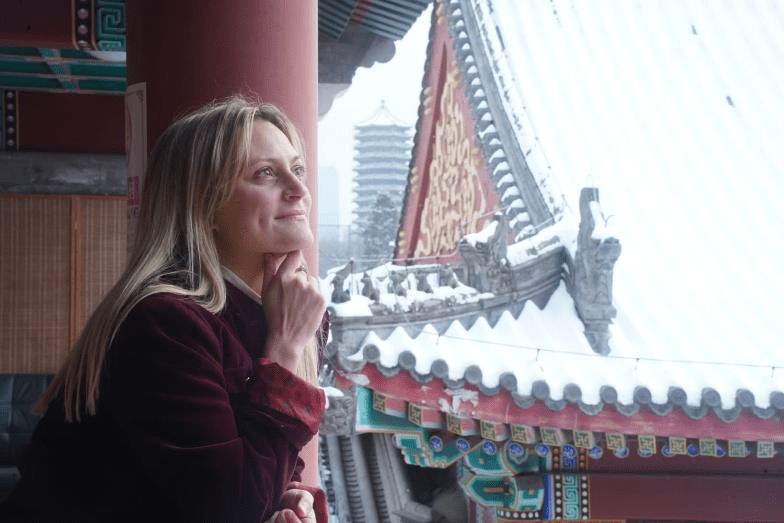

NM: Regarding your recent teaching experience at Southwest University, how have you combined Western and Eastern philosophical traditions in your lectures? Greek philosophy is quite different from Chinese philosophy, so how do your students in China engage with Greek thought? Have you noticed any cultural differences in how students approach these ideas compared to students in Europe?
CB: This is a fundamental question that I am very happy you asked. Saying that Greek philosophy is quite different from Chinese philosophy is certainly true but oversimplistic. While it is undeniable that the two traditions have a different style of reasoning and a different historical and cultural context, they both share a specific philosophical interest for the same questions, that are the most fundamental questions human beings can think of: why do we live? How should we live? How do we relate to others and nature? What is it that we know?
I personally favour a cross-cultural understanding and like to challenge both Eurocentric and Sinocentric views. This is something I bring into my classes as well. During my time at Southwest University, I usually focused on Aristotelian Ethics and Metaphysics in a standard way by presenting and reading the texts with my students, and I liked to finish my classes with open questions for them to discuss certain theories and views across different philosophical traditions. For instance, I challenged both Aristotle and Confucius and looked for points of contact as well as divergence on a certain topic. In this process, I also learnt a lot from my students, both about Chinese authors and definitions and by broadening my views on Ancient Greek texts that I am used to read. In other words, teaching Ancient Greek philosophy in China enriches and challenges my views on concepts that I give for granted and that students coming from a different cultural and linguistic background appreciate differently. It feels like zooming out of the axioms I have built around how I interpret a technical term or a text, looking at them from afar, therefore in a different way, only to zoom back in on them and appreciate them under a new fuller and more comprehensive light.

NM: Thank you for your answer. I imagine your methodological approach is highly stimulating for your students. Teaching philosophy in China must come with its own unique challenges and rewards. How have you adapted your teaching methods for a Chinese audience, especially considering the different philosophical traditions they are exposed to compared to students in Europe? Additionally, you’ve participated in several conferences exploring the relationship between Greek and Chinese civilizations. What insights have you gained from these cross-cultural discussions, and how have they influenced your understanding of both Greek and Chinese philosophy?
CB: Coming from a very solid tradition learnt and practiced in Pisa and Oxford and working in double first-class universities in China, I did not have to change my method significantly. Colleagues and students here tend to know several languages, including Ancient Greek, so I would say that teaching in China is not so much different from teaching in the West. Perhaps one big difference is the almost imperative use of multimedia interfaces and digital tools. But I guess that has changed everywhere after Covid times and it has increased in Europe too.
As I was saying before, I usually like to end my classes with open questions that bring together Western and Eastern philosophy: that opens the floor to the students’ reflections on philosophical dilemmas but also philosophical terms. I can say that one difference I notice is the linguistic reservoir we are connected to in Europe and that is not automatic for Sino-Tibetan language speakers. For example, I can easily reconnect an Italian or German word to their Latin or Greek root and vice versa read and think of certain modern nuances of a specific Ancient Greek word. Of course, all these connections can be learnt, and we also do have to learn them, but coming from another linguistic background poses different questions and creates different links in the mind. I can notice the same about myself while learning Chinese, because coming from a different cultural and linguistic background makes me ask questions that native speakers have never thought of. I think that my work in China is a truly Socratic opportunity to experience a philosophical dialogue where you must be willing to listen to other people’s points of view and frames of mind and question and reevaluate your own ideas and what you have always known. I can say the same about the cross-cultural conferences that I have attended: those are the conferences where a true philosophical dialogue becomes not only possible, but necessary. During my years in China, I have collaborated also with newly established research centers, such as Kelkip, to foster the dialogue between the two cultures. Recently, I presented a paper on The role of reason and emotions in Ancient Greece and Confucian Ethics at a conference about cross-cultural studies at the BNU-HKBU United International College in Zhuhai, where I compared the Stoics with Neo-Confucian Zhu Xi’s psychology, contributing to broader discussions on virtue, rationality, and moral cultivation in comparative philosophy. This has been especially brilliant because I co-presented it with a Swedish colleague who is a historian and sinologist, so we mixed both a philosophical and historical method and perspective while investigating the same bulk of ethical questions, putting together our more technical and different expertise in our respective fields. All these dialogues, both with the students and at the conferences, have made me see Greek philosophy less as a self-contained tradition and more as one voice in a broader conversation about how human beings think and reflect on life and knowledge.

NM: Your research also touches on the influence of ancient Greek philosophy in literature and the arts. How do you see philosophy interacting with other forms of cultural expression like literature or the visual arts? Do you think it’s important to bridge these areas of study?
CB: Very broadly speaking, I think that philosophy touches every aspect of life and can be found in human production as well, so any expression of literature and the arts may draw from philosophical assumptions and vice versa can inspire or push forward philosophical theories. I am an avid reader, film enthusiast and art lover, so I simply cannot refrain from noticing patterns and links between philosophy and the arts. Of course, if we keep aside the very fact that Aesthetics is a specific philosophical branch that deals with technical implications related to art theory and artistic products, what I find most interesting is the portrayal and application of philosophical concepts and abstract ideas across literature and the arts. The beauty of this is that Ancient philosophical ideas are timeless and especially inspiring for the minds of creative people and keep showing up reinterpreted even in some of the most modern artistic products.
NM: One final question: beyond academia, what aspects of life in China have you found most enriching or surprising, and how have they influenced your worldview?
CB: I would define my life in China as fast-paced, futuristic, and convenient despite having lived in two Chinese megalopolis of approximately 22 and 32 million inhabitants. Indeed, as a European, dimensions and distances are something about China that surprised me at first. And not only: more surprising is that life is made accessible, easy, and efficient with a technology that is at the service of the citizens. The speed of change is also incredible and always noticeable: I might be away for a month for my vacation and then come back to a very different and improved campus or a totally new technological payment system. I could name the food, the landscapes or the traditions, but what I love most about China is the people and their optimistic and practical outlook on life. Chinese people seem to have a general tendency of being there for each other and trusting progress and development: they are welcoming and always happy and ready to share their knowledge. One concept that came up several times interacting with Chinese friends and colleagues is ‘yuanfen’ (缘分): it is usually translated as ‘fate’ but it indicates the strength of the bond you may have with other people or things in your life on the basis of how long for and how much you encounter them, something we would translate also as ‘coincidence’. ‘Yuanfen’ has influenced the way I see my life and that of the people around me, the jobs I take on, and the activities I choose to do: interestingly, it has given me more freedom to enjoy each day as it comes. Oh, and one final thing that struck me, especially in comparison with Europe, is the importance that everyone places on learning and the commonly widespread respect for teachers, tutors, educators, professors of any discipline and grade. Being an educator in China is definitely worthwhile.
NM: Thank you, Caterina! It’s been a very enjoyable interview, full of interesting insights. I hope that in the future there will be other opportunities to discuss these topics.
CB: Thank you so much for the great conversation, Nicola! I look forward to our next exchange on philosophy and academic life.
©️Nicola Milanesi | “Introducing Metallurgy to Ming China”, IPM Monthly 4/9 (2025).
 IPM Monthly