

The Setbacks for the Digital Humanities
By Celeste Pedro
April 2025 – I have always been passionate about old books and old scripts. That led me to study many subjects beyond my major, and get to know many online repositories of the most amazing collections. To keep track of developments in digitisation efforts, I follow many Facebook pages set up by Unis, research centres, research projects, museums, libraries, specialists, etc.
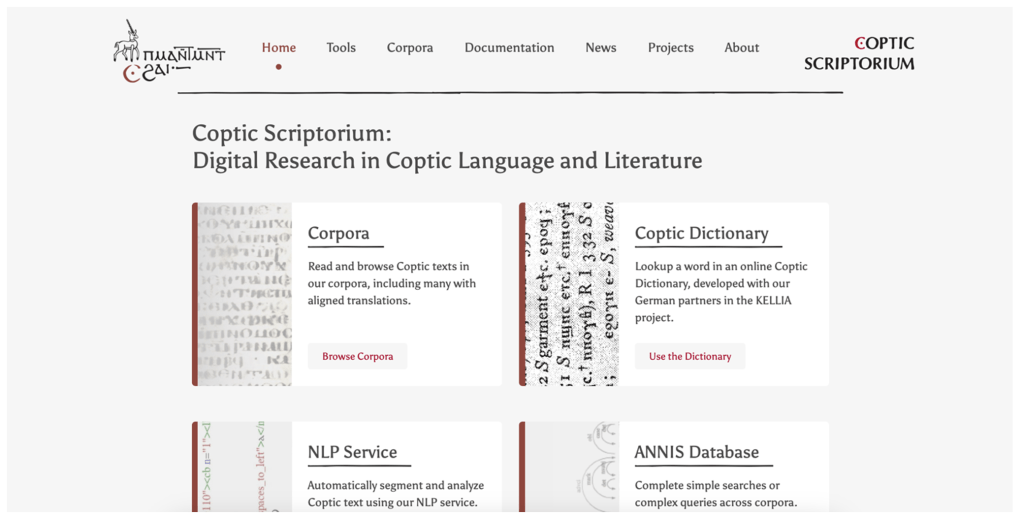
One of those pages is the Coptic Magical Papyri, a project based at the Julius Maximilian Uni. Wurzburg which focuses on Coptic-language magical texts from Islamic Egypt (ca. 4th to 12th century CE). It is not my field of research, but I am fascinated by the script, the images and the diagrams on them. Just a few days ago, they posted a note, saying the Coptic Scriptorum (an open-access interface for Coptic texts) was being defunded. I had to learn more about it.
The Coptic Scriptorium was mainly funded by the National Endowment for the Humanities, USA. It saw its last $100 million from the project’s budget cut, leaving teams to rely on the “kindness of strangers” to continue their work.
The National Humanities Alliance posted on its website: “On Monday, March 31, 2025 we learned that the Department of Government Efficiency (DOGE) is targeting the National Endowment for the Humanities (NEH) with the aim of substantially reducing its staff, cutting the agency’s grant programs, and rescinding grants that have already been awarded.”
And so it happened that it was indeed heavily reduced and cut from an already minimal budget: the National Endowment for the Humanities (NEH) had always been running on low budgets, in 2024 it was funded with $211 million while the National Science Foundation got $9.06 billion, for a quick reference; and now 65% of staff nationwide were let go: “At least 118 of its 180 staff members have been fired so far“, and 1435 projects (worth $427 million) related to the arts and culture, to archeology, public humanities, museums and digital archives, were terminated.
The Association for Computers and the Humanities developed a database to keep track of the cuts.

In regards to the Digital Humanities, the scenario is also grim: at least 245 out of 1435 (84 directly associated with the Office of Digital Humanities, created in 2008) of the terminated awards involve digital resources, reflections on the role of the digital in public outreach or the creation of digital outputs, such as archives or databases.
Those cuts are not confined to the context of the United States, nor do they only affect American-based researchers, such as funding fieldwork or library visits abroad. Critical projects worldwide are significantly suffering the consequences, such as projects targeting the digitisation and digital accessibility of manuscript collections and texts from Ancient periods.
Along with the Coptic Scriptorium, the Perseus on the Web (awarded in 2023 and running until 2026), which feeds new data to the Perseus Digital Library, is now on the list of terminated awards.
Alongside cuts to the NEH, the New York Times reports: “The staff of the independent Institute of Museum and Library Services, the largest source of federal funding for museums and libraries, were put on leave”.
Academia has expressed itself in the past weeks, and joint statements keep emerging. The National Humanities Alliance issued a letter on April 1st, condemning the cuts to funding and staff and has actively promoted counteraction. What we once thought was obvious, is again under threat: “Without funding for preservation, materials will disappear, degrade or not be collected in the first place (…) and once those are lost—they’re lost. The record of human activity is gone”, the Humanities Alliance’s executive director says.
©️Celeste Pedro | “The Setbacks for the Digital Humanities”, IPM Monthly 4/4 (2025).
 IPM Monthly