

“The brilliant histories of art belong to everyone”
By Celeste Pedro
September 2025 – To start off the new academic year, I’m sharing Smarthistory, Centre for Public Art History, a nonprofit online resource created in 2003 by Dr Beth Harris and Dr Steven Zucker, both from the Khan Academy. The platform now hosts over 4,000 essays and 1,000 videos, covering works from ancient Mesopotamia to contemporary art. The entire library is free and openly licensed (Creative Commons), making it widely reusable for educators and students.
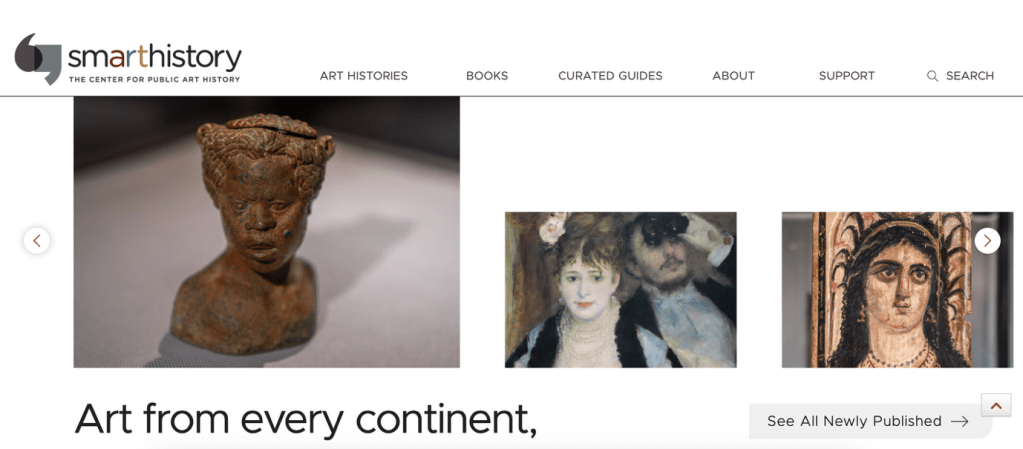
Figure 1. Front page of the website
But this resource is much more than the sum of its amazing visual content. This platform is the result of the meaningful collaboration of colleges, universities, museums, and research centres across the world, surpassing 850 contributors (from art historians, curators, archaeologists, researchers and artists), and all content is peer-reviewed.
Smarthistory is a dynamic platform that uses videos and interviews in loco (at museums and other cultural places) as its main asset in public art education. It is engaging and diverse, easy to use and trustworthy.
The team has shared news of exciting features that came out in the last few weeks. Julie James Silverman (a visiting lecturer at Washington University in St. Louis) announced that “one of the most anticipated features was the new pages dedicated to Place, Artist, Period, Artwork Type, Material, and Technique, better searching capacities; new syllabi; and more.” This makes it easier to find and navigate between subjects, and it is even more relevant for non-specialist users; the long-standing purpose of digital humanities.

Figure 2. Interface for geographic exploration
And what makes it overall useful for the humanities in general and for philosophy in specific? Well, as I see it, among others, it is the Syllabus and the Basics menus. Ever so often, being comfortable with the description and analysis of images (artworks in this case) is a plus; when thinking about how we see, what perceptual features are manipulated in art (form, colour, media) or how attention is guided, and also… art’s role in cultural transmission and identity, or even interpretation, semiotics and hermeneutics, art as expression of power or ideology… some works of art have even notoriously influenced or inspired thinkers and scholars throughout the centuries, and the other way around happened too. Check out this essay on Joseph Wright of Derby, and his painting “A Philosopher Giving a Lecture at the Orrery” by Dr Abram Fox.

Figure 3. Curated guides: the basics
If your work involves a deeper knowledge of thematics related to art history, but your academic background did not, this is a wonderful resource to get to the point quickly and confidently. And since Smarthistory is built on the premise of assisting students and professors, it can also be used for planning philosophy classes, for example, with resources such as these DIY tools to learn more about creating videos, sound and images for art appreciation classes. Enjoy!

Figure 4. The first chapter of the Syllabi: Art Appreciation
©️Celeste Pedro |“The brilliant histories of art belong to everyone”, IPM Monthly 4/9 (2025).
 IPM Monthly