

Mahadurot – Peer-Reviewed, Modular Critical Editions of Medieval Hebrew Texts:
A Conversation with Yehuda Halper
By Katharina Hillmann
December 2024 – One of the problems with critical editions is that they often require prioritizing a single version—whether it be a particular manuscript or the editor’s own rendition—in an effort to reconstruct what is believed to be the original text. However, this approach does not accurately reflect how people historically engaged with texts, as texts were circulated in multiple versions, which served as the foundation for various commentaries and translations.
About Yehuda Halper
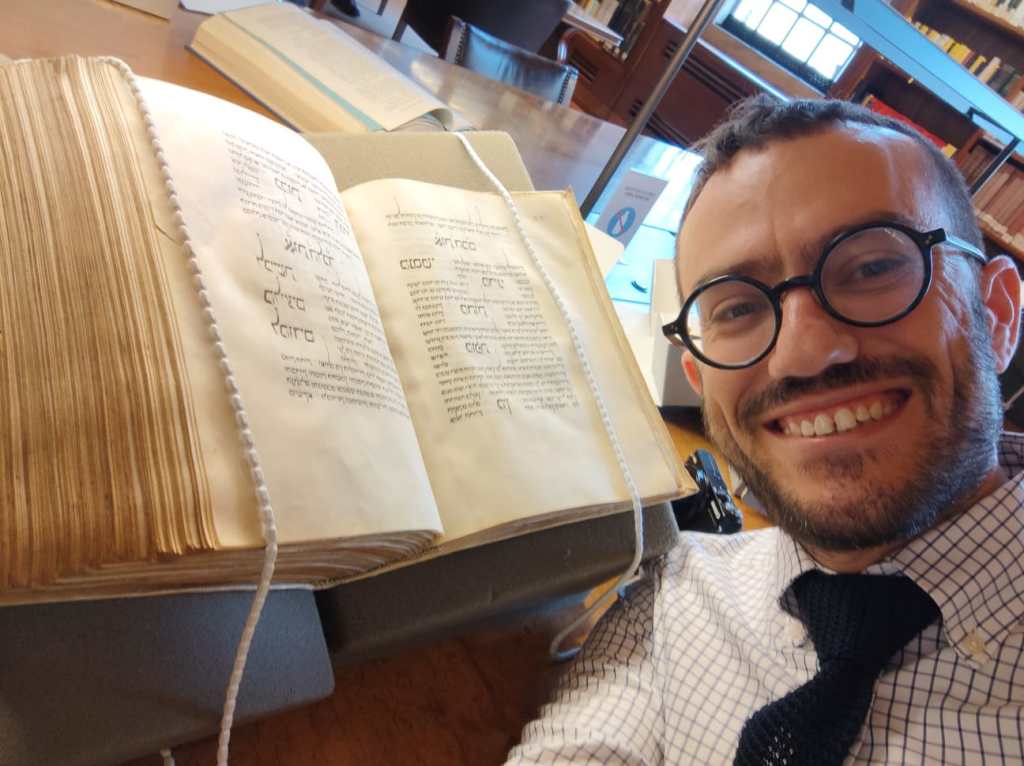
Yehuda Halper is associate professor in the Department of Jewish Philosophy at Bar Ilan University. His research examines medieval philosophy at the intersections of Greek, Arabic, Hebrew, and Latin in Europe, North Africa, and the Middle East. In particular, he is interested in the reception of Plato and Aristotle in translation among medieval logicians and scientists and how Jewish and Muslim thinkers adopted and adapted Plato and Aristotle to form the building blocks of medieval philosophy and science.
His 2021 book Jewish Socratic Questions in an Age without Plato (Brill, Hamburg Jewish Philosophy Series) won the Goldstein-Goren Book award for the best book in Jewish Thought 2019–2021. He is currently the director of the Israel Science Foundation–funded project “Samuel Ibn Tibbon’s Explanation of Foreign Terms and the Foundations of Philosophy in Hebrew (Research Grant #622/22)”, and was the co-organizer of the Israel Institute for Advanced Studies research group “The Reception and Impact of Aristotelian Logic in Medieval Jewish Culture” in 2018–19.
In recent years, Yehuda Halper from Bar-Ilan University has developed a software for editing Mahadurot (Hebrew for “editions.”): Modular Critical Editions of Medieval Hebrew Texts. This innovative project represents a significant advancement in the Digital Humanities – for Jewish Studies and beyond. Mahadurot combines a traditional reading experience with modern comparison tools, enabling users to view any manuscript version in any language alongside other versions, accompanied by a relevant editorial apparatus for each version.
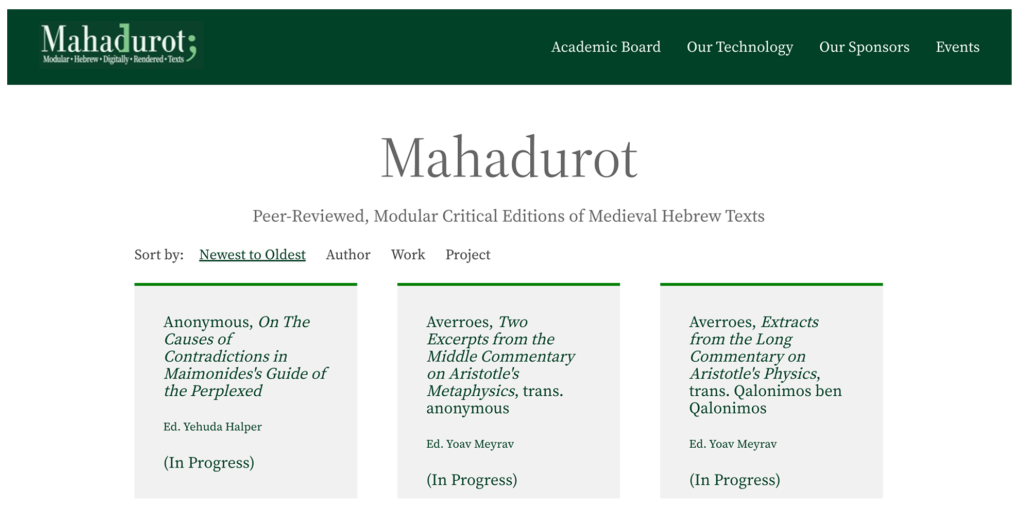
Mahadurot prioritizes editorial transparency by preserving complete versions of all manuscripts, ensuring they can be read in their entirety. It preserves the traditional format of critical editions, while allowing readers to easily compare different manuscript versions and languages. Commentaries, such as marginalia, are displayed next to the corresponding manuscript versions for easy reference. Readers can navigate effortlessly between the text and its apparatus with a single click or may hover over specific sentences to see related apparatus entries in context. Additionally, different versions of the same text can be opened in separate browser tabs for side-by-side comparison, and texts can be copied and pasted as plain text.
Yehuda aimed to create a system that would enable us to view and compare all the different versions of a text. He was particularly interested in commentary traditions: “People were reading, and in some cases writing, commentaries on particular versions of a text,” he explains. This too can be depicted by Mahadurot, which allows us to see how a commentary is based on and relates to a specific version of a text. For example, we can read a commentary on a specific version of an anonymous Hebrew translation of Al-Farabi’s The Art of Dialectic. Mahadurot presents both texts side by side, each with its own apparatus.
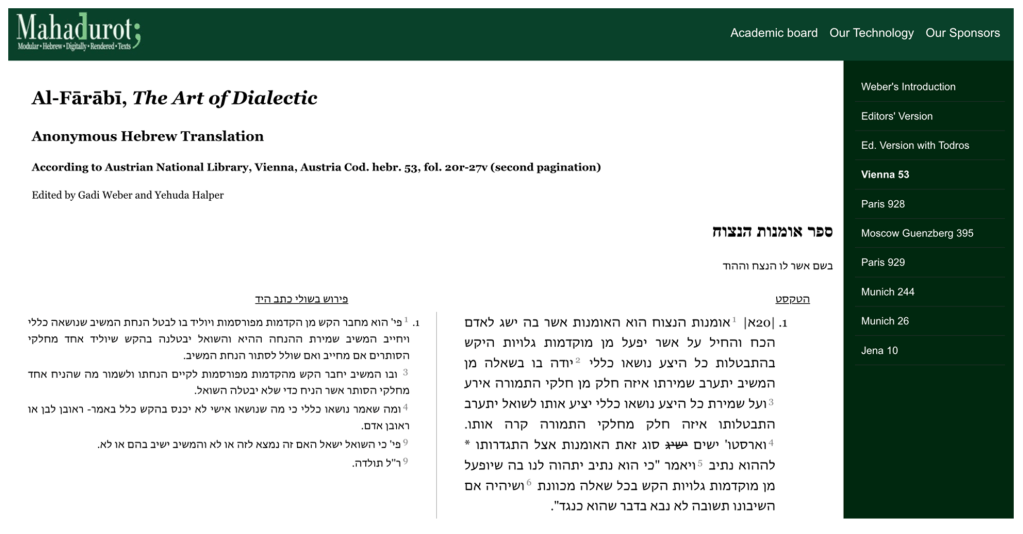
Mahadurot’s technology ensures that editorial decisions do not eclipse the original manuscript version, clarifying any changes made by the editor. The software significantly simplifies and accelerates the editing process, allowing both experienced scholars and PhD students to efficiently edit numerous manuscripts. It improves the accuracy of the stemma by allowing the editor to construct it as a last step, after examining all manuscript data. Mahadurot introduces a new software tool stack that facilitates the creation of modular critical editions of medieval texts, along with an innovative method for building these editions online. The tool stack was inspired by the technical documentation methodologies employed in the software development industry. These rely on industry-standard tools that have been customized by developers to meet the specific needs of the project, alongside the formalization of work processes to enable collaboration across large teams.
The tool stack includes:
– Mahadurot Paragraph Editor (MPE), a web editing interface for tagging the variants of a text and marking those to be noted in the apparatus. MPE simplifies processes for the philologists, while producing an XML tagged file with stable metadata.
– Automatic Apparatus Generator, a plug-in for the creation of a critical apparatus from the XML tagged files. While the critical apparatus appears to be automatically reconfigured when the reader navigates between variant views, in actual fact, the apparatus is built by the plug-in as a static XML file. The plug-in was developed for Madcap Flare by Improvementsoft.
– Navigational enhancements (CSS and JavaScript) for the websites that allow for smoother navigation between linked elements, such as between the critical apparatus entries and the main text, and between the commentaries and the relevant sentences.
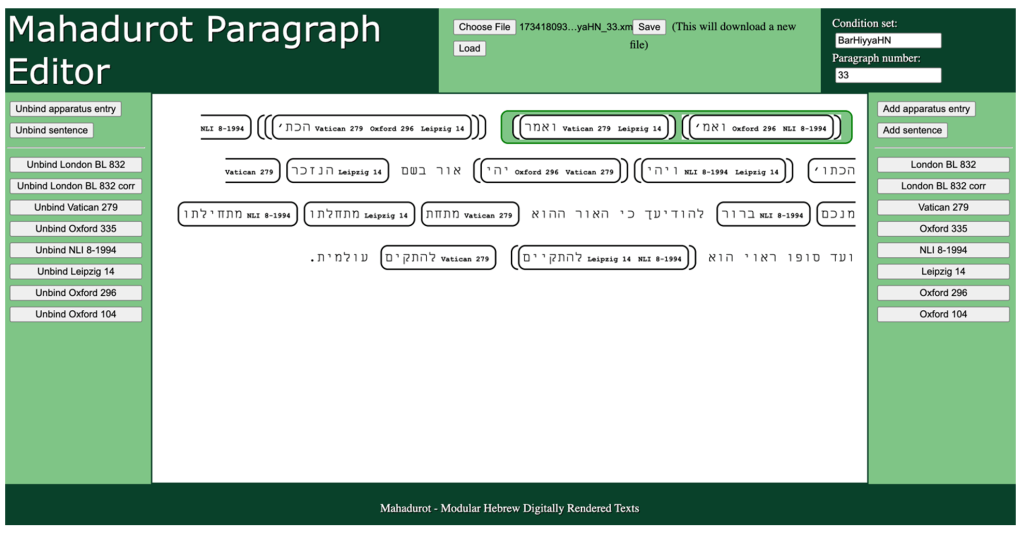
Entering the manuscript readings to create this kind of edition is straightforward: One first types up a single manuscript. Next one compares it to another manuscript in the Mahadurot Paragraph Editor (MPE), writing only the text that is different and then marking the text that is unique to each manuscript using MPE‘s tags. After following this procedure for all manuscripts, one then goes back and tags the readings that one wants for the edited version. Finally, one uses the Automatic Apparatus Generator to generate all of the apparatus for all versions and manuscripts with a single click. One can then use the data from the edition to draw up a stemma, and even rename the sigla at a single click should the need arise (e.g., one can identify manuscript “A” after the apparatus has been initially built).
Yehuda explained how we can utilize the data collected from Mahadurot in our future research, particularly to gain a deeper understanding of a text’s genealogy. In collaboration with the Stemmaweb project (based at the University of Vienna), we can create charts to visualize the differences between various versions of a text and display this information in graphs and collation tables. This will help us reconstruct manuscript groupings and understand the connections between individual manuscripts.
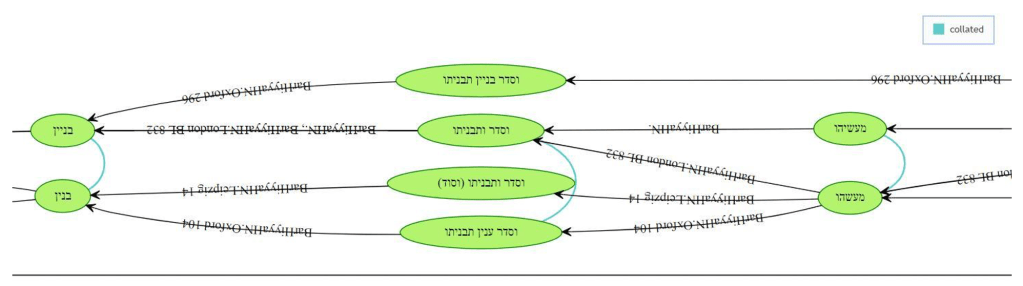
Ultimately, one of Yehuda’s goals is to be able to build charts that can characterize how texts relate to commentaries and how different commentaries interconnect. This will enable us to create a visual network through these graphs, allowing us to identify which manuscripts served as the foundation for different commentary traditions and translations. It will also help us understand which texts were read and distributed across various places and communities. Returning to the significance of commentary traditions, Yehuda explains: If we encounter a later commentator criticizing Gersonides’ interpretation of Aristotle’s Topics, we might discover that they were using a different version of Averroes’ commentary on Aristotle’s Topics in the translation of Qalonimos ben Qalonimos. It is important for us scholars to determine which manuscript they were using, in order to understand whether the differences arise from issues in textual transmission or from genuine interpretive distinctions.
Therefore, one of the most important tasks at the moment is to expand the body of texts. This involves, on one hand, incorporating more Arabic and Latin texts. Currently, a branch of Judeo-Arabic texts from Yemen is already in process to be published (Mahadurot Teman). On the other hand, Yehuda is looking forward to enabling the import of published texts into the format, in order to utilize their data and information as well. With a larger corpus of texts, Mahadurot will be able to integrate AI, as yet another tool to help us identify potential connections and influences for further exploration.
Of course, none of these tools can replace the essential human act of reading, Yehuda concludes, which stands at the beginning and end of all scholarly efforts. What Mahadurot aims to achieve is the creation of new and improved critical editions that will help us become better readers of texts, now and in the future.
References
Development of the Critical Apparatus Plug-In was funded by the Alon Fellowship for Outstanding Young Researchers (Israel Council for Higher Education) awarded to Yehuda Halper (2016-2020).
Software licensing and work on the edition of the anonymous Hebrew translation of Al-Fārābī, The Art of Dialectic was funded by the Israel Science Foundation, Research Grant #2182/19: “Hebrew Traditions of Aristotelian Dialectics,” Principle Investigator: Prof. Yehuda Halper.
©️Katharina Hillmann | “Europeana News”, IPM Monthly 3/12 (2024).
 IPM Monthly