

Fragments: From the Past to Your Screen
By Celeste Pedro
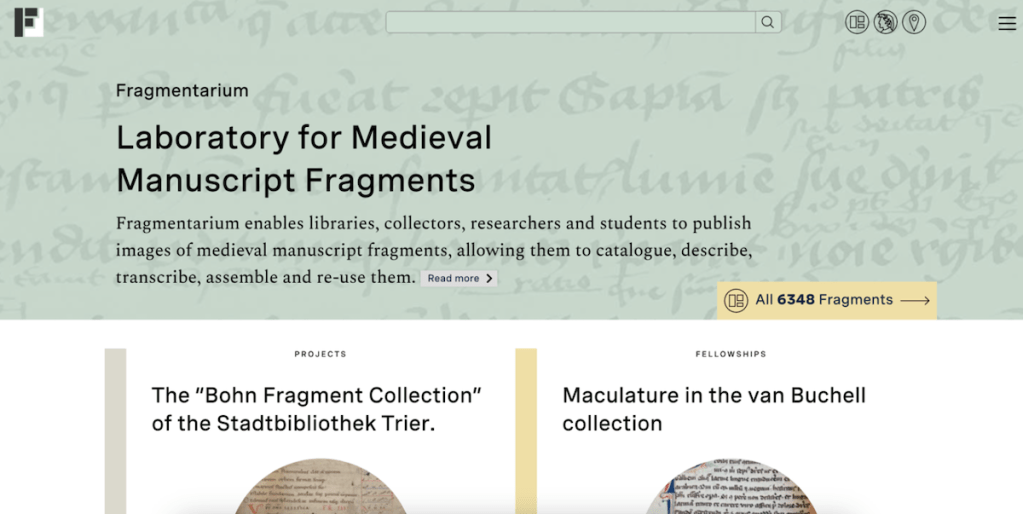
Did you know that many of our libraries’ holdings are fragments? And that fragments are sometimes the only witness we have on important ancient works, enabling us to shed light on lost texts? Fragmentarium is an online platform that works as a collaborative hub for the study of manuscript fragments. Having started as part of e-codices – Virtual Manuscript Library of Switzerland, its scope is now international. Currently holding 6347 fragments, the Fragmentarium database is extremely well-curated; from the detailed descriptions (that can be downloaded in TEI/XML) to its “refined search” options, this website is easy to navigate and visually sober.
In the last decades, fragmentology has had a lot to gain from the digital humanities, including extensive digitization projects of binding materials – which is where we find most fragments, especially in early-printed books, when paper was not yet abundant and many medieval manuscripts where at hand to “recycle”.
Fragmentarium officially started in 2015 after two years of preparation. It had another two years of development and testing with case studies. It was launched with a modest collection, having reached the mark of 5000 fragments in 2023 with the additional new website interface. This was achieved with a large team under PI Christoph Flüeler and funding from the Swiss National Science Foundation (SNF). Fragmentarium is now part of the Manuscript Research Center – University of Fribourg.
But Fragmentarium is much more than that.
Besides its mission to study and preserve ancient manuscript fragments, its aim is to collect, digitise and share medieval fragments with academics and the general public.
Fragmentarium makes it easier for researchers, historians, librarians and anyone interested to study these remnants of materials (made from parchment or paper, mostly) without needing to travel to where the physical fragments are kept. Having a database of well-described and digitised fragments also makes it easier to use software to reassemble them in the original “place” (the torn manuscript), wherever they may be located, or to solve “fragment puzzles”.
The platform also encourages collaboration among institutions and researchers; in that way, users can contribute to a greater understanding of old or lost texts and their contexts. Users can upload their images and metadata (origin, content, history) to the platform, easily adding annotations or research findings. The platform uses advanced tools to help identify and link related fragments, aiding in the virtual reconstruction of manuscripts.
The web application is a cataloguing tool to collect and describe fragments with tags, facets and keywords for cross-checking, and it allows users to assemble fragments visually.
If this is something that interests you a lot, check the project’s open-access Journal – editor: William Duba; Fragmentarium has had programs of fellowships, training and internships, and they develop projects in partnerships with public and private institutions.
Here is an example of a fragment from the Bodleian Library:
https://fragmentarium.ms/overview/F-ar6c
Here is an example of a fragment description:
https://fragmentarium.ms/description/F-5mvk/376
And here are the case studies:
https://fragmentarium.ms/pages/programs#Case
©️Celeste Pedro | “Fragments: From the Past to Your Screen”, IPM Monthly 3/7-8 (2024).
 IPM Monthly