

Empowering Humanists:
Exploring the Potential of Omeka
By Celeste Pedro
It is already evident that we cannot do without the advantages of digital tools and methodologies for scholarly analysis, exploration, and scientific dissemination. And the intersection of new technology and the humanities has opened new avenues for researchers. This month, I’ll briefly present Omeka, an open-source web publishing platform tailored to cultural heritage. It makes exhibiting collections online and organising datasets a versatile and robust undertaking, empowering digital humanists in various aspects of their research aims.
With Omeka, researchers, students and teachers can curate and quickly make their data available, be it images, texts, videos, etc., facilitating the management of metadata and the structuring of multimedia resources they’d like to make available to the public. Its main asset is that it is very user-friendly, with customisable templates and an intuitive (backend) interface, making it easy for researchers and institutions to upload and manage digital items without requiring technical expertise while, at the same time, boosting the creation of immersive and interactive storytelling for historical collections.
Omeka is a Digital Scholar project (the Corporation for Digital Scholarship also developed Zotero and Tropy), originally launched at the Roy Rosenzweig Center for History and New Media. Omeka was released in February 2008 and funded by the Institute of Museum and Library Services (IMLS – Washington, D.C.). The team’s goal was to publish “accessible collections and exhibitions that utilise standards-based metadata (…) by building a free, open-source platform that (…) offered an easy-to-use administrative interface, provided syndication for sharing content, and extended the core function of publishing content with a flexible plugin architecture and rich design theme API.”
There are three versions of Omeka, and the team that developed the software also provides assistance, training and support with hosting and development:
Omeka S was developed to encompass the needs of large cultural organisations and collaborative research projects. It was built specifically to support institutions managing resources from multiple websites (sharing digital collections) with a streamlined installation and linked open data. This version is useful to combine existing datasets and explore the links between them. It also requires more information organisation skills and more technical knowledge.

Omeka Classic is the best choice for individual projects and is available in a large number of languages. You can choose existing themes (layout designs), and you can add plugins for extra features as you go; there’s a large set of them on GitHub already: https://github.com/omeka/Omeka
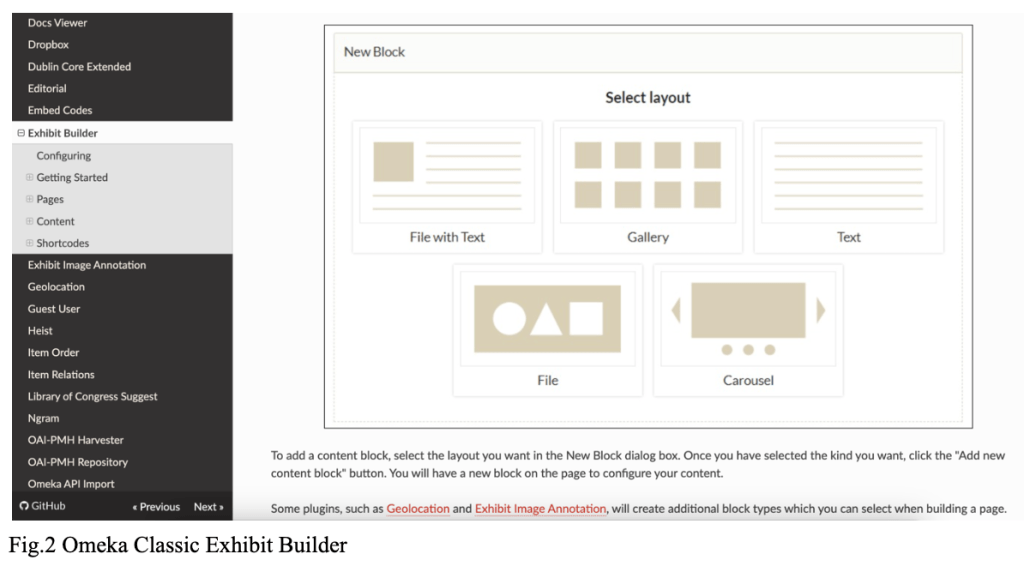
The Classic version, the oldest, is also extremely useful in creating online exhibitions with multiple sections and pages that combine items from your collection in simple steps (for which you might need some storyboard planning first).
Omeka.net: You’ll need to meet specific requirements concerning your system and server for both S and Classic versions. With Omeka.net, you’ve got it all in one. With this version, you won’t need to worry about hosting your website, and you don’t have to install anything; you can just store and edit everything online. No code. This is their paid product, but it is very affordable, considering how much you get from it. I often use the trial version in classes, where students can create, describe and display a small collection of images in just a few steps. Even if they don’t use it in the future, they can get a good picture of the work involved and what can be done with this kind of software. The only downside is that you can’t use IIIF with this version. While in S or Classic, you can use IIIF Toolkit Embeds, for both the Image and Presentation APIs.
Omeka, just like the IIIF, underscores the potential of open-source software for accessing cultural heritage and disseminating research in the Humanities, and they both provide chances to participate in forums and developer communities, where researchers can be part of these tools’ ongoing improvements.
©️Celeste Pedro | “Empowering Humanists”, IPM Monthly 3/3 (2024).
 IPM Monthly