

Digital Tools: DOCASV and Scriptamanent
By Celeste Pedro
September 2023 – This short review covers two digital humanities resources available for the Spanish context. Despite their specificity regarding editorial type and geography, these tools prove how materials can be efficiently made publicly and digitally available to general audiences and how important it is to have scholars cataloguing, indexing, and describing public and private archives. In summa, the considerable effort needed to create such tools is of unquestionable value, and the impact they can have on researchers’ work is not marginal at all.
DocASV
The DocASV was developed from a collaboration between the Universidad del País Vasco/Euskal Herriko Unibertsitatea and the Consejo Superior de Investigaciones Científicas and is dedicated to providing easier access to the ASV. The Archivum Secretum Vaticanum, or, as recently officially re-named, the Archivum Apostolicum Vaticanum, is the oldest and most extensive archive of documental witnesses for the history of the Catholic Church, but also one of the most difficult to have access to. Comprising a timespan of around 12 centuries and composed of c. 600 archival fonds, the ASV is still cryptical to consult, and access is, in fact, limited: it is necessary to have a letter from an academic institute or renowned professor and a certificate of your academic title (even for clergymen), and, for example, inventories and indexes cannot be reproduced (photocopied or digitised). Considering this state of things, the DocASV project aims to facilitate researchers’ work by simplifying the location and identification of documents (as a pilot, medieval records related to the territory of the Basque Country) and by providing resources/guides to help scholars find their way through the immense collections of the Vatican archives.
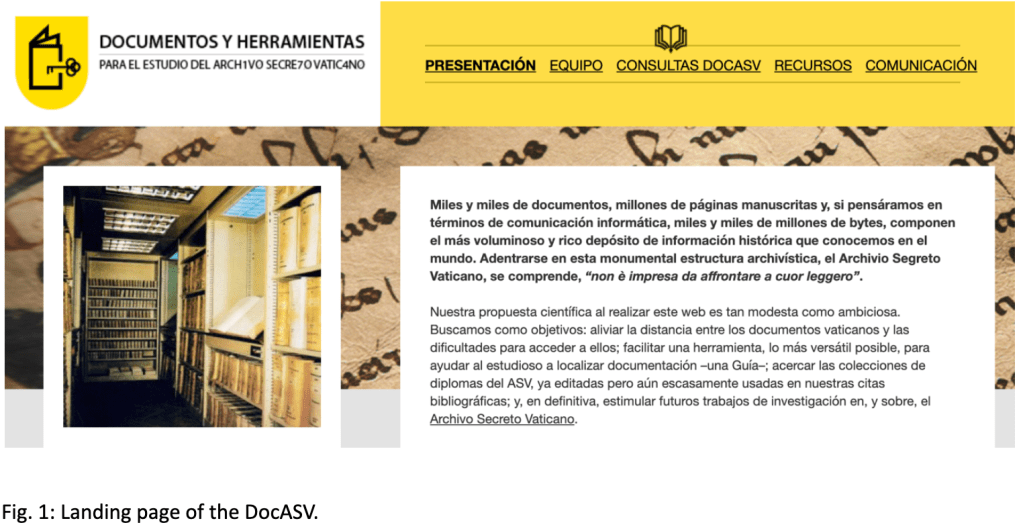
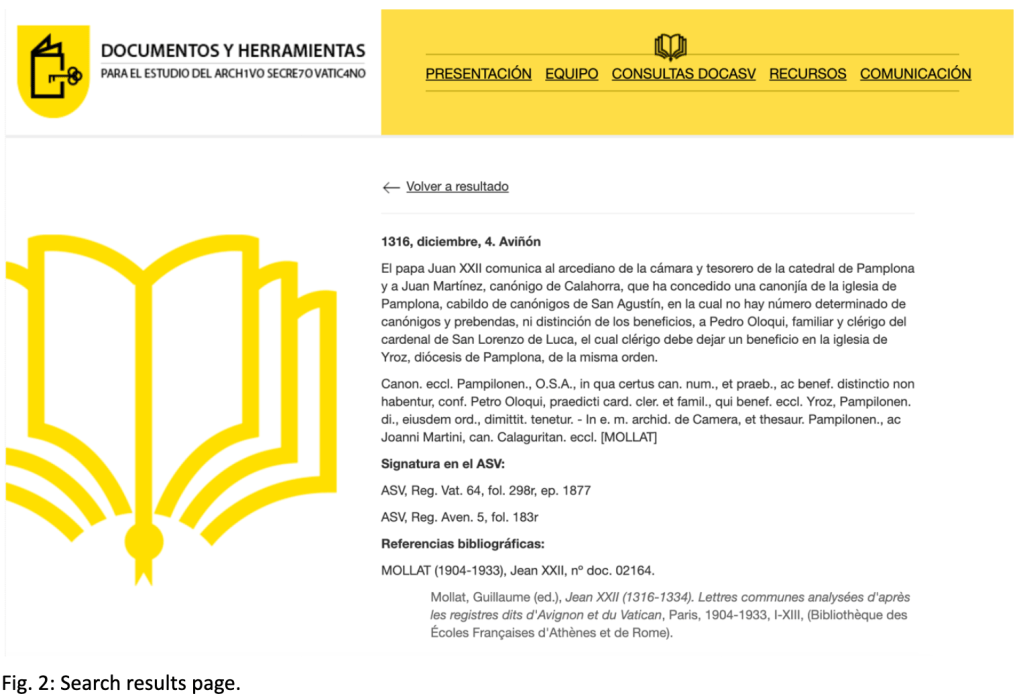
Why an online database of a database? We all know the immense amount of time required to find what one needs in large, poorly, or wrongly described documents, manuscripts, or printed matter, and we all know, or imagine, how much work is involved in cataloguing hundreds, if not thousands of documents. Considering these obstacles, most researchers, archivists, and bibliophiles, in general, have often invested their time preparing the path for the next ones to come; they end up doing what they wished was already done in the hopes that research can progress from their contribution. This is the spirit behind a database like DocASV: improving how information is made available to its audiences. This tool primes for its intuitiveness; it is uncomplicated and didactical. Users can rapidly access all related records by selecting the costumery search fields (year, place, etc.), including up-to-date indexation on the original location within the ASV and bibliography on the topic or witness itself (see example below). Don’t forget to check out the resources page!
Scriptamanent
At a recent congress organised at the University of Zaragoza, principal researcher Cristina Jular Pérez-Alfaro presented the Scripta Manent with a communication titled “Códices abiertos: entre biblioteca, archivo y red”, focused on the third part of the project “From private records to public texts” (running from 2021 to 2025).

Accessing documents is one thing; being able to read them is another. Scripta Manent aims to provide a computerised textual corpus of documents related to family lineages (such as the ones related to the Férnandez de Velasco, one of the most important medieval noble families), registering, transcribing, and editing in full the collected records, available in pdf format so that the public can learn about and question medieval feudal models. The database is divided into two collections: Diplomas (documental records) and Firmas de Escribanos (scribes and copyists’ signatures). Together, they can provide the basis for an overview of the lives of the families and their social relationships, a “social history of power”, and the people who created and ratified the documents.

The project has also been materialising its scholarly usefulness of turning private records into public resources with the work of PhD students, such as the one developed by Raúl Villagrasa Elías: the Rethos (Retia hospitalium) is a collaborative endeavour that collects/stores data on the medieval and early modern Spanish hospitality network.
The Rethos project also developed a tool to visualise the geographical distribution of these historical institutions’ presence in the Iberian Peninsula, together with descriptions related to documental witnesses, such as contracts, for example, architectural details and intervention episodes, known individuals related to the hospitals’ history or bibliography specific to each building. Have a look here!
 IPM Monthly