

Digital Libraries: New Digitisation Projects
By Celeste Pedro
Digital Libraries are now a common thing. Almost every major Public Library has at least part of its collections digitised. Efforts and standards for digital preservation and accessibility have been decades now. Nevertheless, it’s incredible how much is still to be done. Countless fonds are waiting in line for their turn, and the attack against the British Library has revealed how fragile the system can be. Accessing, using and writing about these digital fonds and their corpus is also a way of preserving heritage and transmitting knowledge about them. This month, we’ll briefly present some new digitisation projects that many scholars will surely welcome in the coming years.
The Joanina Digital
Considered by tourists and influencers as one of the most beautiful libraries in the world, the Biblioteca Joanina (Unesco World Heritage) is located in Coimbra, Portugal, at the heart of the University. It was built in the first half of the 18th Century by King John the V and houses around 60 thousand volumes (from the 16th to the 18th c.). The volumes are publicly accessible on-site but have never been under a digitisation project until now.

The project expects to digitise around 30 thousand old books over the next six years, including important works by Vesalius, Kepler, Coronelli or Newton. As they get digitised, they will be (re)catalogued, and have their preservation status checked. It has a budget of around 8 million euros, financed by the Sharjah Book Authority – SBA. For the first 12 months, there will be a pilot concerning editions about the Middle East, the “Biblioteca Sultan bin Muhammad Al-Qasimi”, and the first outcomes are expected to be released in November: the 32 volumes of La Galerie Agréable du Monde (1729).
When the project is in full run, it is expected to be a repository of open and interoperable structured image-text functionalities, with a strong accent in knowledge organisation and dissemination through digital exhibitions, incorporation into Europeana and with data tools to help analyse the vast corpus. This platform, the Joanina Digital, is being developed by UCFramework, a spin-off of the University of Coimbra, responsible for the digital repository of the General Library of the University Alma Mater, in which Joanina will be incorporated.
462 medieval manuscripts from Speyer, Worms, and Mainz
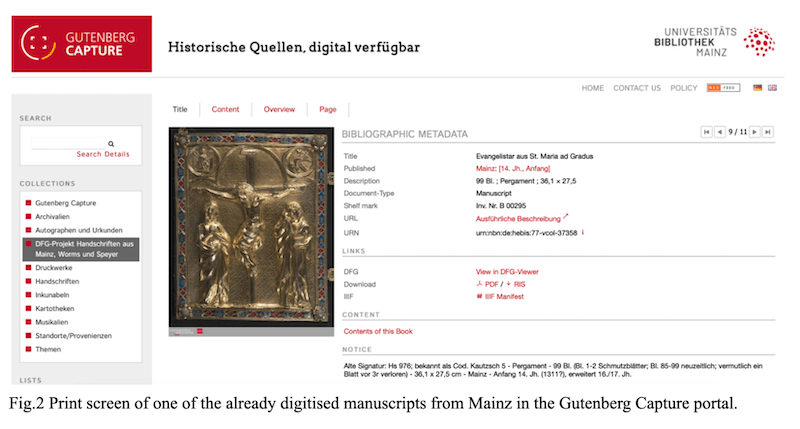
The University of Mainz, together with four more libraries and research centres, will be developing a three-year 310 thousand-euro digitisation project funded by the German Research Foundation, aimed at making available the medieval manuscripts of public institutions in the areas of the Middle Rhine. Starting in the 9th Century but more significantly composed of 14th-century manuscripts, these collections have already begun to be treated. They will be made public and usable through the Gutenberg Capture portal of the Mainz University Library.
You can already find digitised manuscripts from this project on this website.
Shorter news on digitisation
The University of Münster is adding new Greek manuscripts from the Vatican Library to its New Testament Virtual Manuscript Room. If you wish to be updated on what the VL is digitising, check on a weekly basis: https://www.wiglaf.org/vatican/
©️Celeste Pedro | “Digital Libraries: New Digitisation Projects”, IPM Monthly 3/5 (2024).
 IPM Monthly