

A New Chapter in Medieval Philosophy Publishing: An Interview with Roberto Limonta
By Nicola Milanesi
November 2025 – Today we interview Roberto Limonta. He is the series editor of the historical collection Biblioteca di cultura medievale, published by Jaca Book (Milan). He has worked as an editor for several publishing houses and curated the first catalogue of Umberto Eco’s modern library and manuscript archive. A historian of medieval philosophy, he conducts research at the Universities of Salerno and Parma, focusing on monastic thought.
About Roberto Limonta
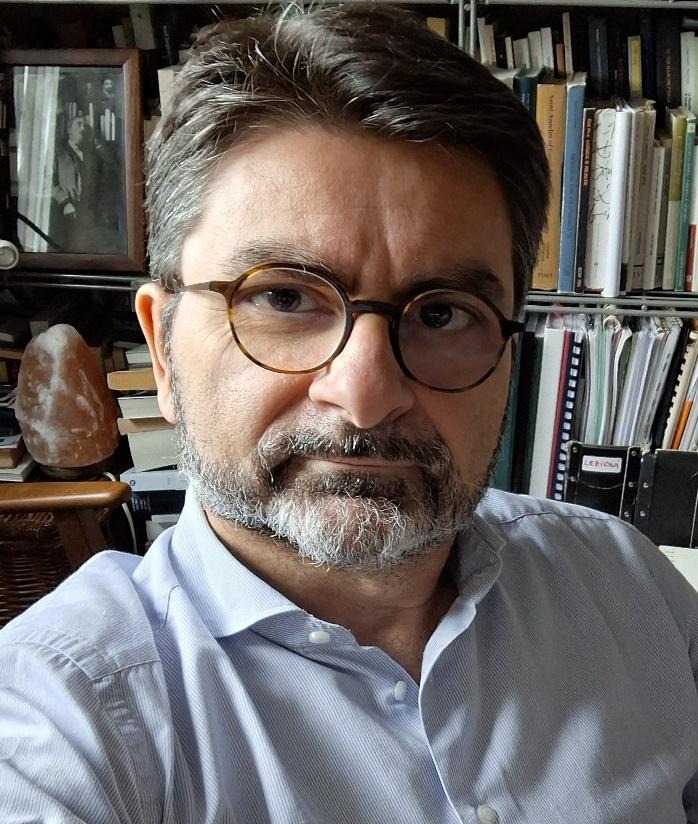
Roberto Limonta is the series editor of the historical collection Biblioteca di cultura medievale, published by Jaca Book (Milan). He has worked as an editor for publishing houses as Mondadori, Encyclomedia, and Laterza, and curated the first catalogue of Umberto Eco’s modern library and manuscript archive. A historian of medieval philosophy, he conducts research at the Universities of Salerno and Parma. His work focuses on monastic thought, particularly on Anselm of Canterbury and Peter Damian. His research interests include divine omnipotence and the philosophy of language, especially the epistemological domain of prophecy, divine (and demonic) foreknowledge, divination, and future contingents. His most recent publication is the monograph La vergine e l’onnipotenza. Guida a “De divina omnipotentia” di Pier Damiani (Milan, 2025).
The Interview
Nicola Milanesi: We’re here today with Roberto Limonta, series editor of the Biblioteca di cultura medievale, published by Jaca Book. Thank you for joining us, Roberto. The series you now direct has long been a reference point in Italian publishing, known for its distinctive identity and its important role in shaping medieval studies in Italy. Could you tell us about its beginnings, the main stages of its development, and the aims that have guided its mission to promote and enrich the study of medieval philosophy and culture in Italy?
Roberto Limonta: Hi Nicola, it’s a real pleasure to be here – thanks for having me! Telling the story of the Biblioteca di Cultura Medievale is, in a way, telling the story of medieval studies publishing in Italy. The series was launched in 1981 with Marie-Madeleine Davy’s Initiation Médiévale, with a title that was a sort of program of the new series. It was a time of renewed fascination with the Middle Ages, following the worldwide success of The Name of the Rose. During that period, landmark works appeared, such as Jacques Le Goff’s La naissance du purgatoire (1981), but the revival also involved popular culture – from Liliana Cavani’s Francesco to mainstream films like Excalibur and Ladyhawke, not to mention fiction. From a historiographical standpoint, these were years of sustained debate concerning the very nature of historical inquiry and the status of the Middle Ages as a conceptual category rather than a mere chronological period. Scholars from Duby and Le Goff to De Rijk – who provocatively asked whether the Middle Ages were, in any sense, a “typically medieval” age – and Alain de Libera, who went so far as to suggest that the Middle Ages, strictly speaking, never existed, all contributed to this re-examination. At the same time, the popular success of works such as Vacca’s Il medioevo prossimo venturo (1971) revealed how enduringly potent the image of a dark and misogynistic Middle Ages remained as a cultural metaphor. The challenge, then, was to read the spirit of the time, to capture the vitality of the intellectual debate and turn it into an occasion for cultural education. It was in this context that the Biblioteca di Cultura Medievale was founded by Inos Biffi and Costante Marabelli, as its conceivers and editors, together with Sante Bagnoli, director of Jaca Book. Looking back today, after nearly fifty years of publications, the editorial and scholarly orientation clearly emerges: the preservation of the theological and spiritual memory of the Middle Ages, and the shaping of a cultural identity grounded in a veritas perennis still able to speak meaningfully to the present.
NM: With such a wide and ambitious program, what do you think have been the main achievements or, if you like, the main strengths of the project?
RL: Among its historical merits, I would first mention the richness of its catalogue and its openness to fields of inquiry such as Islamic and Jewish philosophy, mysticism, and the study of women in the Middle Ages – areas that were, at the time, scarcely explored, yet which the editors were able to identify with an almost divinatory sensitivity. The Biblioteca di Cultura Medievale made a decisive contribution to the Italian scholarly debate, fostering its openness to the international context and to the most up-to-date developments in research. Over the years, it has made available works that remain useful tools for scholarship: the Opera omnia of Anselm of Canterbury in Italian translation, studies of the French historical school – from Chenu and Marrou to Boulnois and De Libera – as well as major monographs by Étienne Gilson, and the body of work on medieval logic collected in the Cambridge History of Later Medieval Philosophy, translated almost in its entirety as La logica nel medioevo.
NM: Let’s move to the present. Your appointment as series editor comes at a time of deep transformation in the publishing world, a moment defined by challenges that, until recently, would have been hard to imagine: from the digital transition to the rethinking of how cultural content is produced, shared, and experienced. In this ever-changing landscape, what choices do you see as key to launching a genuinely new chapter for the series – one that remains faithful to its history and identity, yet ready to engage with the demands and opportunities of the present?
RL: Thank you for the question, Nicola, it gives me a chance to get to the heart of some crucial issues. The current publishing landscape is marked by a general crisis in the field of non-fiction, and medieval studies are no exception. Academic production today largely lies in the hands of specialized publishers. A significant shift has occurred in the criteria used to evaluate research which reflects the adoption of models where research output is primarily assessed through papers in specialist journals, while historical syntheses and translations have been relegated to a secondary position. It is easy to see how this creates a void, affecting precisely those publications most needed in teaching contexts, where students often struggle with texts that lack facing translations.
In this context, what does it mean to inaugurate a new season of a medieval series? The image of a “season” appeals to me, for it evokes the freshness of renewal within a cycle that regenerates what has gone before. I would return to the first volume of the series, published in 1981, and to the title of the accompanying editorial, “Identity and Memory,” with which the collection was inaugurated – though reinterpreting its meaning. In Italian, the term identità can be either singular or plural: today, I would understand it in the second way, as a representation of a non-monolithic Middle Ages – an interweaving of cultural traditions and of a medieval scholarship enriched by dialogue among different historiographical schools. A Middle Ages that belongs as much to Thomas Aquinas as to Siger of Brabant, to the Kalām and the Qabbalah, to Gilson no less than to De Libera. As for memory – which is not merely a repository of recollections but an active faculty – it involves navigating between Scylla and Charybdis: on the one hand, a modernization that proceeds by superficial analogies with the Middle Ages; on the other, the deprecatio temporum of those who turn an ideological Middle Ages into an antidote to the ills of modernity.
Historical study always begins from an irreducible distance from its own time. To “engage with the present,” therefore, is to undertake a dialogue with the contemporary world that proceeds not from contrived similarities but from otherness and difference—for discontinuities define our object of study no less than continuities. And it is precisely this otherness, recoverable only through the rigour of historical inquiry, that makes the Middle Ages a reservoir of original insights, still capable of nourishing contemporary debate. All this must, of course, take shape in concrete editorial choices. This entails, first of all, the publication of new titles: secondary literature and translated sources with facing texts. Secondly, the reissue of works from Jaca Book’s historical catalogue.
NM: The project is truly fascinating! That said, I believe a crucial turning point for any publishing initiative lies in defining its target audience. Who is the series aiming to reach today? And how do you plan to balance the need to maintain a high level of scholarly rigor with the desire to engage curious, culturally aware readers who may not belong to the academic world – offering them quality outreach without sacrificing the complexity of the subjects involved?
RL: You’re absolutely right, Nicola: defining who the series is intended for is a fundamental part of the work. The aim is to offer both tools for research and university teaching, and works capable of engaging the interest of the non-specialist reader—thus reaffirming the series as a resource for the scholarly community and also for the wider dissemination of knowledge about the Middle Ages. A series, even apart from the metaphor, is an object defined by the elements that compose it and by the relations among them.
The balance between high-quality dissemination and rigorous scholarship, which undoubtedly guides the work of the series, is sometimes achieved within a single volume itself – as in the case of Marrou’s Saint Augustin et la fin de la culture antique or Heers’s The Medieval Cities. At other times, this balance can be discerned across the catalogue as a whole, where works of wider appeal – such as the captivating biography of Brunhild – alternate with more demanding studies, like Gilson’s Duns Scotus or Luca Parisoli’s La filosofia dell’obbedienza (Philosophy of Obedience), which we have recently published.
There are also cases, however, in which a single text may accommodate multiple levels of reading: such is the Handbook for the Education of My Son William by Dhuoda, a work that may move the general reader with the poignant testimony of a woman who lived through the iron centuries of the Middle Ages, while offering scholars and students alike a rigorous critical edition, complete with facing Latin text and an introduction by the historian Massimo Oldoni.
NM: Does the series aim to follow or give preference to any particular historiographical or scholarly approaches? Are there areas of research – perhaps ones that have been less explored in the past, or that have recently emerged in the international field of medieval studies – that you intend to highlight in order to foster a fresh and stimulating critical perspective on the Middle Ages?
RL: I believe that the guiding principle of the series must be to provide a space for the historiographical orientations emerging from current research, without ideological preclusions. As for the work of renewal, its first focus is naturally the historical catalogue of the series, through a program of re-editions. This is the case, for instance, with Dhuoda’s Handbook, now republished with the Latin text on facing pages, an updated bibliography, and a new introduction. I would also like to broaden the scope of the series, engaging with the debates of the past decade on what is meant by “Middle Ages” and by “medieval studies”, extending them to the so-called “Long Middle Ages”.
It is not easy to identify shared research areas within a landscape long marked by fragmentation into what Loris Sturlese has aptly described as “cultural microcosms”. Nonetheless, certain themes stand out: women’s philosophy; semantic and logical-linguistic issues, which are helping to unsettle ideological readings of entire historical periods; the study of vernacular philosophy, which invites a salutary reconsideration of relationships between genres and historiographical categories; and the continued exploration of traditions of Arabic, Bizantine, and Jewish thought.
Yet I also believe that we should not hesitate to engage with issues arising from the contemporary world, lest we fall into the trap of demonizing an epoch in advance, just as the moderns once did with the Middle Ages. The series already includes titles that make use of contemporary categories to examine medieval phenomena; but dialogue with modernity may also take other forms, such as reflections on the digitalization of historical sources, or specific themes such as, for example, that of forgery—a subject on which Umberto Eco and Maria Bettetini have already worked, and which today is attracting attention in the debate on information and fake news.

NM: One last question, about the upcoming publications. Looking at the projects currently in progress, which titles or thematic directions do you see as most representative of the direction you’d like to give the series? Could you briefly tell us about the paths or areas of focus that you consider emblematic of this renewed cultural vision?
RL: Absolutely! Since June 2024, when Vera Minazzi and Sante Bagnoli entrusted me with the editorship of the series, we have published nine volumes, with two further titles to appear before the end of the year. Without diminishing the importance of the others, I would single out three that exemplify the cultural direction of this new phase: the first is the already mentionned Dhuoda’s Handbook. Then two recent publications: Parisoli’s La filosofia dell’obbedienza (Philosophy of Obedience. The Franciscan Tradition), notable for its ability to engage contemporary categories of thought through a historically meticulous reading of medieval texts; the second, if I may, my own La vergine e l’onnipotenza. Guida a “De divina omnipotentia” di Pier Damiani (The Maiden and the Omnipotence. Guide to Peter Damian’s De divina omnipotentia), which seeks to interpret and contextualize a text within the longue durée of its reception history and through a conceptual repertoire drawn not only, but also, from contemporary thought.
The forthcoming publications continue along the cultural and editorial lines I have described. In this light, Renato de Filippis’s La logica di Dio (The logic of God) presents Boethius’s Opuscula sacra with a facing Latin text, an extensive critical apparatus, and an equally substantial introduction – the most up-to-date monograph on Boethian theology to date. This will be followed by the reissue of a classic: James Weisheipl’s biography of Thomas Aquinas. Much else is in preparation: we hope to reissue shortly Alain de Libera’s La philosophie Médiévale, still in high demand.
The year 2026, moreover, will mark the Franciscan anniversary – an opportunity to highlight key titles from the historical catalogue, such as Étienne Gilson’s monumental Duns Scotus, which we have recently republished, among others. The publishing house is also in negotiation to acquire the rights to several international titles that explore promising areas of research and would help fill certain gaps in the Italian scholarly market. But on that, allow me to say no more for now.
NM: Thank you, Roberto! It’s been a really engaging conversation – I hope to have you back soon to tell us more about the progress of the Biblioteca di cultura medievale series.
RL: Sure. Thank you, Nicola, it’s been a wonderful conversation!
©️Nicola Milanesi | “A New Chapter in Medieval Philosophy Publishing”, IPM Monthly 4/11 (2025).
 IPM Monthly