

Thomas on Tour: Meditations on the Afterlife of St. Thomas Aquinas’ Mortal Remains
By Alexander Lamprakis
April 2025 – It’s not every day you get a Whatsapp text about a medieval saint’s skull coming to town. But there it was—pinging into my phone: “Skull of Italian saint Thomas Aquinas comes to Utrecht in April.” Although I have studied Thomas as a philosopher, I must confess that I had never thought of him being actively venerated as a saint. So I was all the more surprised to see his skull go on a world tour on the scale of a rock band, including accompanying newspaper articles and paparazzi shots of his skull in the passenger seat of a Jeep. I always thought relics were venerated in the places where they were kept, as these places attract millions of pilgrims and visitors every year. It was therefore surprising to see Thomas’ skull visiting the faithful in the places where they live. The occasion of this tour is three jubilees: 2023 marked 700 years of his canonisation, 2024 the 750th anniversary of his demise and 2025 the 800th anniversary of his birth. As a comparison, Taylor Swift’s critically appraised (and overlapping) Eras Tour lasted from March 2023 to December 2024, so not quite as long.
Naturally, I paid my respects. Apart from the phenomenological experience, the visit to Thomas’ skull was, above all, an opportunity for me to learn something (something I’m sure Thomas would have approved of). At the information board that accompanied Thomas’ relic, I was able to download the very informative article by Anton ten Klooster (Tilburg University) about the afterlife of Thomas’ mortal remains via a QR-code.[1] I immediately delved into it and learned that Thomas’ trip to the US and Europe was not the Dominican’s first post-mortem journey. In fact, the afterlife of Thomas’ mortal remains is material for at least one true-crime podcast, if not an entire Netflix series. It includes the political turmoil at the time of the Papal Schism, with the rivalry between France and Italy at the time (Thomas died in Italy but was later transferred to France), as well as the jealousy and disputes between the Cistercians, Dominicans and other religious orders (Thomas died in a Cistercian abbey but was himself a Dominican).
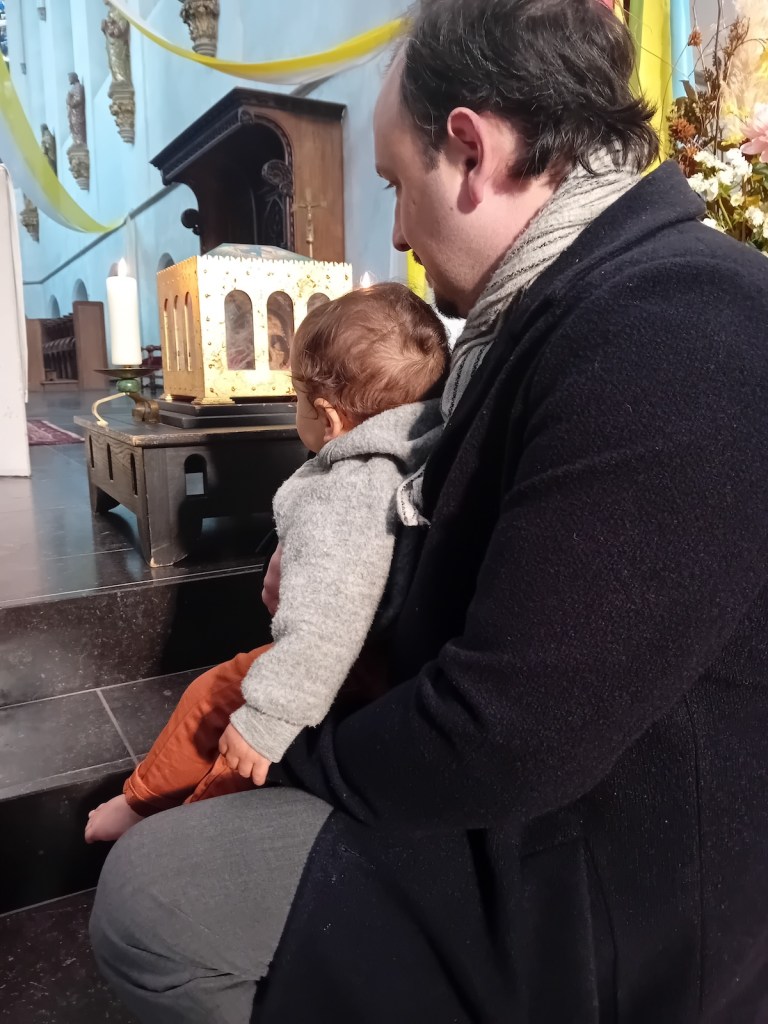
The stories do not lack more graphic details, either. Some Dominicans (or forces close to them), I learned, made the accusation that a Cistercian had boiled the body of Thomas in order to separate the flesh from the bones (Thomas’ body was exhumed and found to be incorruptible several decades after his death), which were then moved and scattered in several places. It might be the case that at the alleged time, the skull of Thomas I was looking at was separated from the rest of the body and sent to Toulouse, while other parts were passed on to other recipients.
It is more likely that such stories were the product of malice and intrigue. At this point, I was not surprised to learn that even the chief inquisitor Bernard Gui, well known from Umberto Eco’s The Name of the Rose, had a hand in the fabrication of reports concerning the rightful place of Thomas’ earthly remains. Of course, the story would not be complete without a second skull to rival the one kept in Toulouse and now on tour. This one was found in 1585 in Fossanova, where Thomas’ remains were kept before being transferred to Toulouse (had they sent a fake skull and kept the real one for themselves?). Until further DNA testing is carried out, the Curia allows both skulls to be venerated, but regardless of which skull turns out to be Thomas’, connoisseurs and enthusiasts of his philosophy will surely agree that it is hard to imagine that all these thoughts could have been contained in a single head.
Standing in front of Thomas’ skull, which is exposed in a modest box decorated with two angels and leaf ornaments, I was reminded of my first visit to the Louvre in Paris. As I waited in an uncomfortably large group of people to enter, I overheard a group of tourists in front of me discussing Leonardo Da Vinci’s masterpiece, the Mona Lisa. Completely dumbfounded, one of them explained to his friends that he had “heard” that the painting of the Mona Lisa was really only “this big” and gestured to its size. The others in the group hardly believed this statement and asked: “Really?” What baffled them was the thought that they were seeing something that was much smaller than its cultural significance suggested. The effect, I now think, can be described as a kind of ‘reverse’ experience of the sublime. Instead of being overwhelmed by the actual size of, say, the pyramids that one has only known from postcards, one is humbled by the smallness and ordinariness of something that one has greatly magnified in one’s imagination.
This amazement at the fact that something is much smaller than most of its reproductions came to my mind when I stood in front of the skull of the legendary Saint Thomas Aquinas in the Cathedral of Sint Catharijne in Utrecht. I myself have often seen Thomas depicted in churches, books, and posters, for example, as enthroned and triumphant over Averroes. I must admit that I myself thought, “really?” when I stood in front of the osseous remains of this thinker’s once mighty head. This impression is reinforced by the fact that Thomas had a legendary corpulent figure, which led to a few legends and also earned him some humorous nicknames. Having been so blatantly informed about the afterlife of Thomas’ mortal remains, I now cannot help but wonder how many Cistercians it may have taken to (allegedly!) cook this imposing and incorruptible body and produce the skull I am looking at. Alongside the opportunity for veneration, the history of Thomas’ skull thus offers a lesson about the darker sides of human nature and reinforces the need to overcome such vices through philosophy. Thank you, Thomas, and see you next time.
[1] Anton ten Klooster (2019). “‘Due honor to their relics’: Thomas Aquinas as Teacher and Object of Veneration”, European Journal for the Study of Thomas Aquinas, 37 (1), 1-17.
©️Alexander Lamprakis | “Thomas on Tour”, IPM Monthly 4/4 (2025).
 IPM Monthly