

The Byzantine Sykeon Is There, and It Is Visible on Google Street View!
by Aleksandar Anđelović
September 2023 – While reading an amazing article by Barbara Crostini on the theft of the Holy Cross from a Byzantine village of Sykeon in the eleventh century, the exotic name of the village spurred my interest in this place and I wanted to check if there are any remains of this village in Türkiye today. I realized that, apart from being known for Theodore, a seventh-century ascetic and afterwards a saint whose Vita was well known in subsequent centuries in Byzantium, next to nothing is known about this place, despite its importance as the crossroads for merchants and armies in as early as Roman times. Further surfing brought me to another fascinating 20-year-old article, by David Barchard, that deals with this place and provides some more information on its alleged location.
Sykeon, rightly claims the article, was located in the Byzantine province of Galatia near the border with Bithynia, what is today central Türkiye, and, more specifically, near the village of Tahir, south of the modern town of Beypazari, at a site that the locals call Kiliseler. The author states that “in September 1995, the writer and Peter Brown of Princeton University discovered a terraced slope, strewn with late Roman pottery” at this site. This gave me some hope that there are some exciting Byzantine remains there, yet simply finding the village of Tahir did not help much. Seeing from both articles that the town is believed to have been located at the confluence of two rivers, Sangarios (today river Sakarya) and Siberis/Hieros (today Kirmir stream), which corresponds to the border between Galatia and Bithynia in Byzantine times, I tried to find those rivers and their confluence. (Fig. 2)
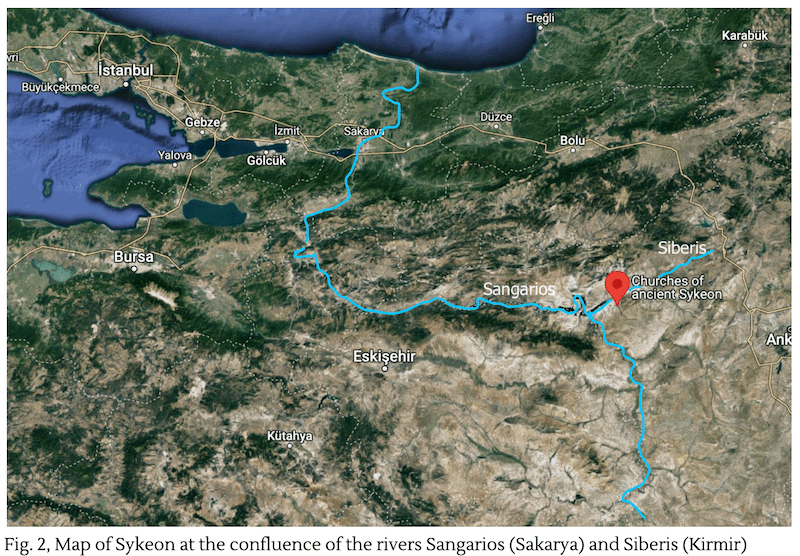
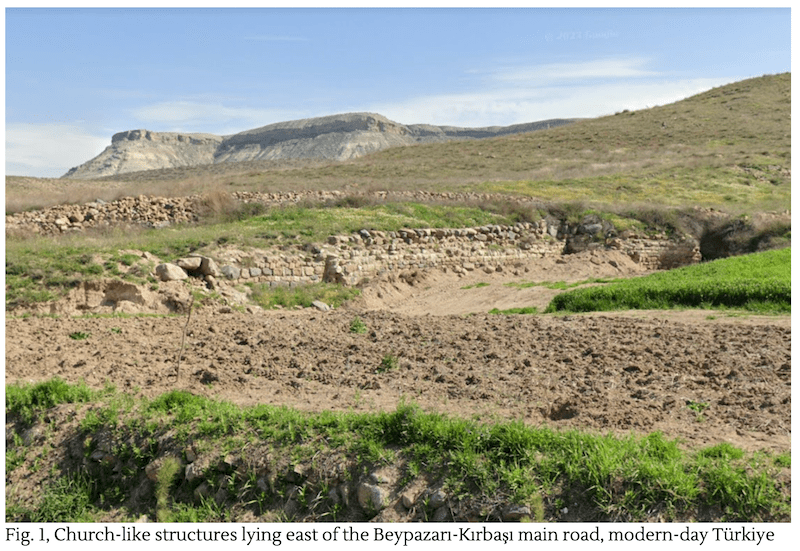
Despite the modern Sarıyar and Gökçekaya dams on the Sakarya river that created a lake that did not exist in Byzantine times, the two valleys and the confluence are clearly visible. Now I knew where to search for the ancient and medieval village. What I did, as every map fanatic using the possibilities Google Maps offer, is going via the main road from Tahir towards the river with the help of Google Earth. As I saw in Barchard’s article the panorama of a hill below which Sykeon is believed to have been located, I tried to find the same panorama from the Street View. And there it was, the same panorama in the article from 2003 and the one that the Google Street View car grasped! (Fig. 3)

Now I knew not only that Barchard and Brown, in the late 90s, were on the right way, but also that Google Maps can help unravel the ancient village of Sykeon!
In the meantime, I read that Barchard and Brown spoke to the locals:
“I explained to the local people that a famous holy man called Theodore had once lived in the vicinity and we wondered where he might have been based. Could they offer any suggestions? To my surprise, this elicited the immediate reply that he must have lived at a nearby place called Kiliseler (Churches).”
Churches! Why was the site called Kiliseler, or ‘the Churches,’ by local people in this area at the end of the 20th century? I therefore tried to find a church-like structure from an aerial view next to the main road near the place where the panorama was taken. And there it was, even two of them (Fig. 4)! (coordinates 40.052136, 31.860593)
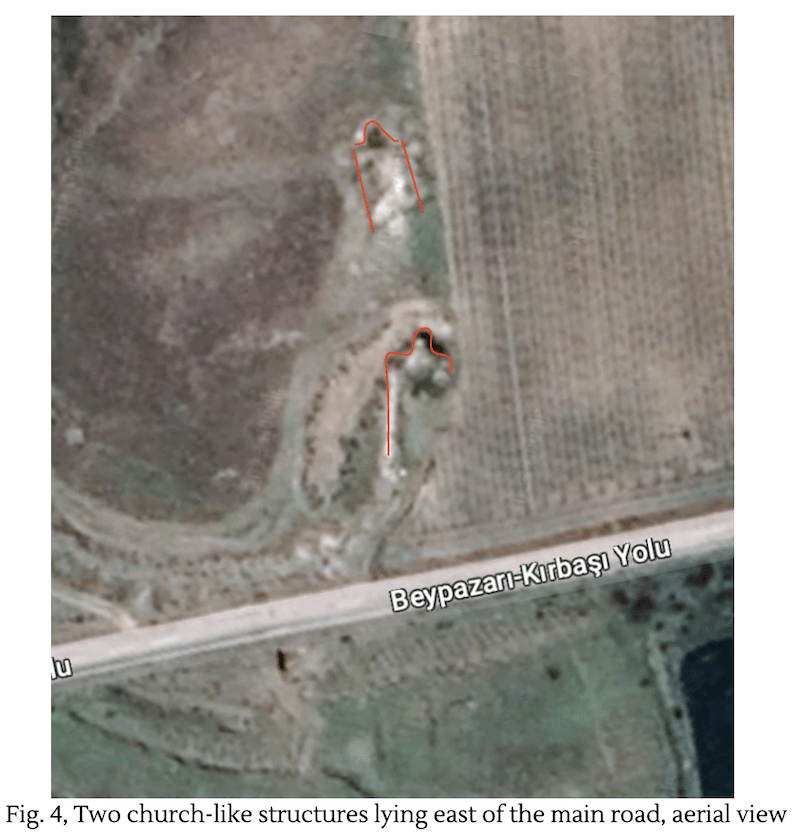
Now, it is true that Barchard noted that there is a church-like structure to the east of the road, but that it is a good 600m from the terraced area on the panorama mentioned above to which the locals pointed the curious visitors. Still, can we discard the two church structures to the east of the road, also connected to the name ‘the Churches’ the locals use for this area? The answer might be given by archaeologists whose expertise is certainly wider in this area than mine. Speaking of which, I deeply wonder why Sykeon and its ‘Churches,’ with the exception of the Tahirler project from the 90s (yes, their website still exists!), remains largely out of interest for archaeologists and the wider public. I therefore hope this mini digital travelogue of mine I shared here will attract the attention of archaeologists who would then do justice to this intriguing Byzantine village and thus contribute to our knowledge on travels, mobility and infrastructure of the Byzantine empire outside Constantinople as well.
 IPM Monthly