

Mariana PTKS – Arte Urbana, Cosmologia e Muita Cor
Mariana PTKS – Urban Art, Cosmology and Lots of Colour
by Eduarda Machado

[Portuguese]
Este mês a Secção Coffee Break convida todos a explorar o mundo vasto da pintura urbana. Entrevistamos Mariana PTKS – pseudónimo de Mariana Patacas -, artista urbana e visual, natural do Porto, Portugal. Iniciou-se na pintura ainda na escola. Experimentou materiais e técnicas, e descobriu as possibilidades da dimensão da arte mural.
Mariana vive e expressa as interrogações profundas da filosofia e da ciência pela arte, pela cor e pela forma. O seu caminho de inspiração faz-se por momentos de contemplação da natureza, a interna e a externa, se é que é possível uma distinção na sua conceção artístico-conceptual. A sua atividade artística gravita em torno de temas como cosmos e a sua origem, bem como as suas infinitas possibilidades, a composição constitui-se maioritariamente por paletas de cores vibrantes e formas harmoniosas.
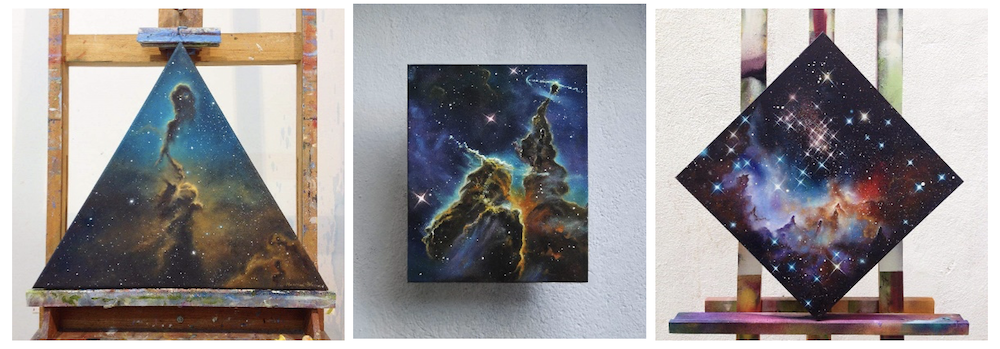
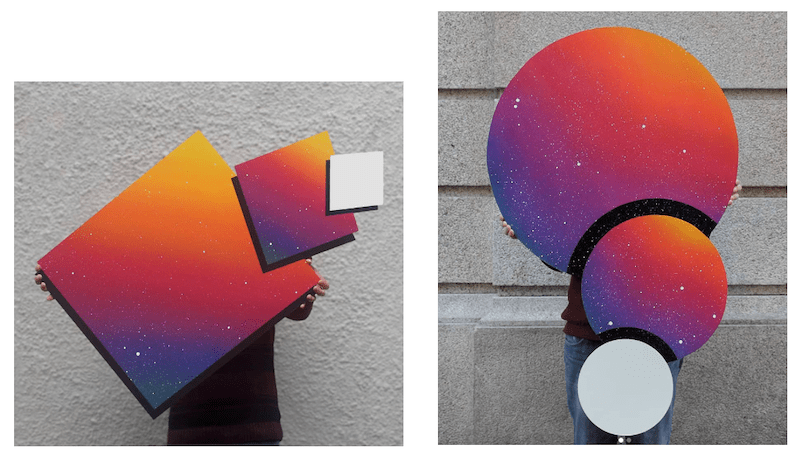
O seu trabalho apresenta simultaneamente coerência interna e uma evolução expressivas exponencial, desde representações realistas de imagens satélite do cosmos em telas pouco convencionais, ao minimalismo da forma geométrica que dá espaço à expressão da vibração da cor, desvelando paisagens oníricas e intensas. Nos seus trabalhos está também consciente do impacto social, político e ambiental e como pode usufruir disso para contribuir para uma sociedade melhor
[English]
This month the Coffee Break section invites everyone to explore the vast world of urban painting. We interview Mariana PTKS – pseudonym Mariana Patacas – an urban and visual artist from Porto, Portugal. She started painting while still at school. She experimented with materials and techniques and discovered the possibilities of the dimension of mural art.
Mariana lives and expresses the deep questions of philosophy and science through art, colour and form. Her path of inspiration is made by moments of contemplation of nature, the internal and the external, if it is possible a distinction in her artistic-conceptual conception. Her artistic activity gravitates around themes such as cosmos and its origin as well as its infinite possibilities, the composition is mostly constituted by vibrant colour palettes and harmonious shapes.
Her work presents both internal coherence and an exponential expressive evolution, from realistic representations of satellite images of the cosmos on unconventional canvases, to the minimalism of geometric form that gives space to the expression of the vibrancy of colour, revealing dreamlike and intense landscapes. In her works he is also aware of the social, political and environmental impact and how she can take advantage of this to contribute to a better society.
A Entrevista
Eu penso que em última instância um artista não escolhe o tema o seu objeto; porém, penso que reconhece profundamente a razão pela qual trabalha esse mesmo objeto. Porquê o cosmos, as infinitas possibilidades, a geometria e o onírico? O que te fez deparar com isto e querer trazê-lo à produção artística?
Eu considero-me uma pessoa bastante espiritual, sempre fui. Sempre fui fascinada pela lua, desde que me lembro de a conseguir ver. Também sinto que me afeta de alguma maneira a natureza e que tem um efeito sobre mim quase primordial. Não sei explicar. Então, pensei, por que não representar algo tão puro quanto isso, tão intrínseco ao meu ser como a adoração pela natureza e por tudo o que a natureza engloba, não é?
Também nunca quis fazer algo com que eu não me identificasse totalmente. Quis ser trabalhadora independente, artista, porque não me via a trabalhar para outros a seguir as normas dos outros. Quem já trabalhou como designer sabe o que isso é no mundo da arte e do design. Foi exatamente por causa disto que eu abandonei o design e me dediquei a full-time à arte urbana.
Os temas que envolvem o meu trabalho são complexos. Vão às áreas da ciência e até de ciências não reconhecidas como tal, como a astrologia, por exemplo. Vou buscar inspiração, não necessariamente a coisas visuais. Por exemplo, eu vejo uma nuvem bonita e é isso que me inspira, não. Não é assim que acontece comigo. Por vezes, no tempo em que me dedico aos meus pensamentos, penso em alguma coisa que que se vai transformar num conceito para uma obra.
Inspiro-me bastante na geometria. Já me inspirei mais. O meu trabalho já foi mais essencialmente geométrico do que é agora. Entretanto, senti um pouco falta do figurativo. Não abandonei a geometria, continuo a gostar muito, mas neste momento não estou a desenvolver um trabalho tão geométrico. Porém, anteriormente eu senti-me muito ligada às fórmulas da geometria sagrada, porque elas vêm de cálculos matemáticos. A matemática, sendo uma linguagem literalmente universal, faz emergir muitas questões, aliás, infinitas questões que dão “pano para mangas”, para pensar, o que é que estas formas significam para nós e, quem sabe, para outras civilizações, outros seres que existam no universo.
Outra coisa que me inspira na natureza é o mundo dos fungos. O mundo da geologia. São coisas que eu quase que sinto uma força magnética puxar-me para esses assuntos, por mais que eu não queira, especialmente o dos fungos. É muito interessante. Eu gosto de ir na rua e conseguir identificar um cogumelo que vejo a crescer ao pé de uma árvore ou qualquer coisa. Dado que é uma coisa que eu gosto bastante – passar tempo na natureza (se me inspira, tenho de passar tempo com ela) – gosto de saber aquilo que estou a ver. Gosto de saber que árvore é aquela, que pássaro foi aquele que que vimos. Acho que são pequenas coisas que, como dizia José Saramago, «se podes olhar, vê. Se podes ver, repara.». Acho que a citação é assim. E eu gosto de reparar. Não ser aqui uma mera espectadora nesta Terra, mas poder compreender os segredos que ela esconde. E acho que também isso vem um bocadinho da minha personalidade, talvez ser um bocadinho uma pessoa mais virada para o interior, para o meu eu. Acabo por pensar muito nestas coisas e nas ligações que existem entre tudo. E é assim que nasce, um pouco, o meu trabalho – da observação, da admiração e pela adoração ao mundo natural.
The Interview
The first question that immediately comes to mind when I think of your work is “Why?” I think ultimately an artist does not choose the subject matter, let’s call it that; but I think they deeply recognise the reason why they work on that very subject matter. Why the cosmos, the infinite possibilities, the geometry and the dreamlike? What made you come across this and want to bring it into artistic production?
I consider myself a quite spiritual person, always have been. I’ve always been fascinated by the moon, ever since I can remember being able to see it. I also feel that it affects me somehow in nature and has an almost primordial effect on me. I can’t really explain it. So I thought, why not represent something as pure as that, as intrinsic to my being as the adoration for nature and all that nature encompasses, right?
I also never wanted to do something that I didn’t fully identify with. I wanted to be self-employed, an artist, because I couldn’t see myself working for others following other people’s norms. Anyone who has ever worked as a designer knows what that’s like in the art and design world. It was exactly because of this that I abandoned design and dedicated myself full-time to urban art.
The themes surrounding my work are complex. They go into the areas of science and even sciences not recognised as such, like astrology, for example. I get inspiration, not necessarily from visual things. For example, I see a beautiful cloud and that’s what inspires me, no. That is not how it happens to me. Sometimes, in the time I dedicate to my thoughts, I think of something that will become a concept for a work. I get a lot of inspiration from geometry. I have been more inspired. My work was once more essentially geometric than it is now. However, I missed the figurative a little.
I haven’t abandoned geometry, I still love it, but at the moment I’m not developing such geometric work. However, previously I felt very connected to the formulas of sacred geometry, because they come from mathematical calculations. Mathematics, being a literally universal language, brings up many questions, in fact, infinite questions that give “food for thought”, to think, what do these forms mean for us and, who knows, for other civilisations, other beings that exist in the universe.
Another thing that particularly inspires me in nature is the world of fungi. The world of geology. These are things that I almost feel a magnetic force pulling me towards these subjects, however much I don’t want to, especially that of fungi. It’s very interesting. I like to go out and identify a mushroom that I see growing at the foot of a tree or something. Since it’s something I like a lot – spending time in nature (if it inspires me, I have to spend time with it) – I like to know what I’m seeing. I like to know what that tree is, what that bird was that we saw. I think these are small things that, as José Saramago said, “if you can look, see; if you can see, notice”. I think that’s how the quote goes. And I like to notice. Not being a mere spectator on this earth but being able to understand the secrets it hides. And I think that also comes a little bit from my personality, maybe being a little bit a person who is more turned inwards towards myself. I end up thinking a lot about these things and the connections that exist between everything. And that’s how my work is born, a little bit – from observation, from admiration, from the adoration of the natural world.

A tua motivação e inspiração é fascinante. Relativamente a influências, há algo ou alguém que te influencie no teu trabalho?
E eu gosto bastante de me inspirar, especialmente nas viagens que faço. Gosto sempre de desenhar bastante do meu caderno, porque o meu trabalho vive muito das paisagens. Então eu como gosto de ir buscar referências ao mundo natural. Acabo por fazer pequenos rabiscos no caderno que às vezes acabam por vir a ser incluídos em projetos maiores. Porque uma composição que já existe na natureza será sempre menos forçada do que qualquer composição que eu possa produzir, não é? E também gosto muito de ler livros de arte, consumir arte, de outros artistas, por exemplo, do século passado. Por exemplo, a Bridget Riley – gosto bastante – Frank Stella e Ellsworth Kelly são artistas que eu gosto bastante. E alguns artistas de arte urbana, portugueses especialmente. Gosto de me manter a par do trabalho deles.
Your motivation and inspiration is fascinating. Regarding influences, is there anything or anyone that influences you in your work?
I like to get inspired a lot, especially on the trips I take. I always like to draw a lot from my notebook, because my work lives a lot from landscapes. So, I like to get references from the natural world. I make little doodles in my notebook that sometimes end up being included in larger projects. Because a composition that already exists in nature will always be less forced than any composition I might produce, right? And I also love reading art books, consuming art, from other artists, for example, from the last century. [hums] For example, Bridget Riley – I quite like – Frank Stella and Ellsworth Kelly are artists I quite like. And some urban art artists, Portuguese especially. I like to keep up to date with their work.

Entre tantas possibilidades porque escolheste a arte urbana?
Eu comecei a dar os primeiros passos na arte urbana no último ano da licenciatura. Em que eu tinha uma cadeira de pintura e tínhamos uma proposta de trabalho que que tínhamos que utilizar apenas as cores primárias e em formas geométricas e a sobreposição delas ia criar as cores secundárias. E então eu tentei fazer aqui com diversos materiais mais tradicionais. Depois um amigo meu arranjou-me uns sprays e eu fiz ali umas “brincadeiras” com spray e depois evoluiu para técnica stencil, que também fiz pelo Porto, um pouquinho. E entretanto, nessa mesma altura, fizemos uma exposição de trabalhos da licenciatura no Porto, chamada StreetArt Axa. Esta exposição foi feita a partir da utilização de um edifício que estava devoluto e no qual houve intervenções artísticas em todos os andares, completamente aberto ao público. Foi algo muito criativo feito na cidade na altura e que me inspirou. Embora já gostasse de morais, ainda não me via a fazer arte urbana mural. Mas ver aquilo exposto ali, num sítio que eu já conhecia e de grande referência e centralidade na cidade (ao lado da Camara Municipal e de edifícios de igual cariz) e eu tinha a possibilidade de conhecer alguns artistas e falar com eles. Foi fantástico e abriu me imenso os meus horizontes para aquilo que eu poderia fazer. Se vou pintar, porque não pintar também na parede?
Among so many possibilities, why did you choose urban art?
I started to take the first steps in urban art in the last year of my degree. I had a painting subject, and we had a work proposal that we had to use only the primary colours and geometric shapes, and the overlapping of them would create the secondary colours. And so I tried to do it here with various more traditional materials. Then a friend of mine got me some sprays, and I did some “games” with the spray and then it evolved into the stencil technique, which I also did around Porto, a little bit. And meanwhile, at the same time, we made an exhibition of graduation works in Porto called StreetArt Axa . This exhibition was made from the use of a vacant building in which there were artistic interventions on all the floors, utterly open to the public. It was something very creative done in the city at the time, and that inspired me. Although I already liked morals, I still didn’t see myself doing urban mural art. But seeing it displayed there, in a place that I already knew and of great reference and centrality in the city (next to the City Hall and other buildings of the exact nature) and I could meet some artists and talk to them. It was fantastic and it really opened my horizons to what I could do. If I’m going to paint, why not also paint on the wall?

Fala-nos um pouco acerca da tua escolha técnica de pintura, de materiais e suportes de pintura. Porque é que usas estes materiais e não outros? Têm um papel fundamental na forma como expressas estas ideias?
Do tempo que tenho vindo a desenvolver a minha arte, tenho vindo a experimentar diferentes materiais. E acho que já cheguei a uma altura em que já tenho certos materiais e médios, suportes, com que eu já estou mais familiarizada, já vi que resultam melhor. De uma forma ou outra, ou sou mais fáceis de arranjar, ou sou mais económicas, então eu acabei por me focar em alguns materiais, como por exemplo os painéis de madeira, de contraplacado marítimo, que é aquilo que tem mais qualidade, na tela, que eu posso vender tanto em rolo como com o agrado, o que facilita também o envio, por exemplo, de painéis de contraplacado marítimo. Ou para sítios mais longínquos. Portanto, são esses materiais que eu utilizo principalmente, também às vezes pinto em telas feitas de alumínio. Que também proporcionam uma superfície mais homogénea, mais suave e é uma opção interessante.
Eu gosto de pintar com materiais que me permitam com maior facilidade fazer gradientes. Por exemplo, o eu fazer gradientes vem muito de eu ter começado a experimentação com o spray, porque o próprio spray permite com o manuseamento da lata, de uma certa maneira, criar aquele efeito difuso. Claro que eu também posso fazer isso com acrílico, com óleo, com aguarela por exemplo. Mas pronto, tenho ficado mais pelo spray, também utilizo o aerógrafo com tintas à base de água, porque é uma ferramenta que também permite fazer os mesmos efeitos que o spray. O tamanho mais pequeno, que é o único senão que a tinta e spray tem, é que abaixo de um certo tamanho pode escorrer, pode borratar. Então eu investi num aerógrafo para poder fazer novas experimentações e gosto bastante. E é isso. Em termos de materiais, não sou uma pessoa muito esquisita, pinto com qualquer coisa. Também gosto de pintar morais com tinta plástica. Gosto de ter alguma consciência ambiental no que toca à utilização de sprays. Portanto, tento evitar um pouco. Embora seja algo que eu gosto muito de utilizar, tento utilizar com moderação.
Tell us a little about your choice of painting technique, materials, and supports. Why do you use these materials and not others? Do they play a fundamental role in the way you express these ideas?
Since I have been developing my art, I have been experimenting with different materials. And I think I’ve reached a point where I already have certain materials and mediums, supports, with which I’m already more familiar, I’ve seen that they work better. One way or another, either I’m easier to get, or I’m more economical, so I’ve ended up focusing on certain materials, like, for example, wood panels, marine plywood, which is what has more quality, on canvas, which I can sell both in roll and with pleasure, which also makes it easier to send, for example, marine plywood panels. Or to more distant places. So, those are the materials I mainly use; I also sometimes paint on canvases made of aluminum. Which also provides a more homogeneous surface, smoother, and is an interesting option.
I like to paint with materials that allow me more easily to make gradients. For example, my doing gradients comes a lot from having started experimenting with spray because the spray itself allows the handling of the can in a certain way to create that diffuse effect. Of course, I can also do that with acrylic, with oil, with aquarelle for example. But I have stayed more with the spray, I also use the airbrush with water-based paints because it is a tool that also allows me to do the same effects as the spray. The smaller size, which is the only drawback that sprays paint has, is that below a certain size it can run, it can smudge. So I invested in an airbrush to be able to do new experimentations and I really like it. And that’s it. In terms of materials, I’m not a very weird person, I can paint with anything. I also like to paint morals with plastic paint. I also like to have some environmental awareness when it comes to using sprays. So I try to avoid it a little bit. Although it’s something I really like to use, I try to use it sparingly.

A arte urbana tem muitas vertentes desde o graffiti, à instalação de rua, poster e projeção. Também pode ser intervenção artística, social, política. Que tipo de projetos fazes?
O tipo de projetos que eu faço mais são comissões em sítios privados, por exemplo, em empresas, em casas. Isso permite uma discussão mais intimista, de certa forma, com o cliente. Também gosto muito de trabalhar com marcas. Acho que é muito gratificante, mas é algo que nem sempre tenho a oportunidade de fazer, porque é um mercado um bocadinho mais competitivo do que já o da arte, já é competitivo, imagina trabalhar com o market. Também gosto muito de fazer trabalhos com crianças e jovens – workshops, projetos em escolas – mesmo com adolescentes, por exemplo, jovens em risco de abandono escolar. Gosto dessa vertente de trabalho mais ao nível social. Acho que também é bom sentir que faço a diferença, não é? E pronto, estes são os tipos de projetos que eu faço fora do estúdio. Dentro do estúdio gosto de ir desenvolvendo o meu trabalho na medida em que não estou sempre a produzir esse sentimento, porque acho que isso também torna a arte assim um bocado, não sei, vulgar. Se calhar não é bem este o termo, mas pronto, entendem o que eu quero dizer.
Gosto de ir produzindo com pés e cabeça, também para não me perder em séries demasiado extensas e também para tornar o trabalho um bocadinho mais exclusivo, se calhar.
Urban art has many strands from graffiti, to street installation, poster and projection. It can also be artistic, social and political intervention. What kind of projects do you do?
The kind of projects I do more commissions in private places, for example, in companies, in houses. This allows for a more intimate discussion, in a way, with the client. I also really enjoy working with brands. I find it very gratifying, but it’s something I don’t always get the chance to do because it’s a slightly more competitive market than the art market, it’s already competitive, imagine working with the market. I also enjoy working with children and young people – workshops, school projects – even teenagers, for example, young people at risk of dropping out of school. I like this aspect of work at a social level. I think it’s also good to feel that I make a difference, isn’t it? So, these are the types of projects that I do outside the studio. Inside the studio I like to develop my work in the sense that I’m not always producing that feeling, because I think that also makes art a bit, I don’t know, vulgar. Maybe that’s not the right word, but you know what I mean.
I like to produce with head and feet, avoid getting lost in too long series, and make the work a little more exclusive, maybe.

O teu atelier é algo bem pitoresco e fica num sítio especial do Porto, creio. Onde fica? O que significa para ti o atelier uma vez que muita da tua arte é feita no exterior diretamente para o público?
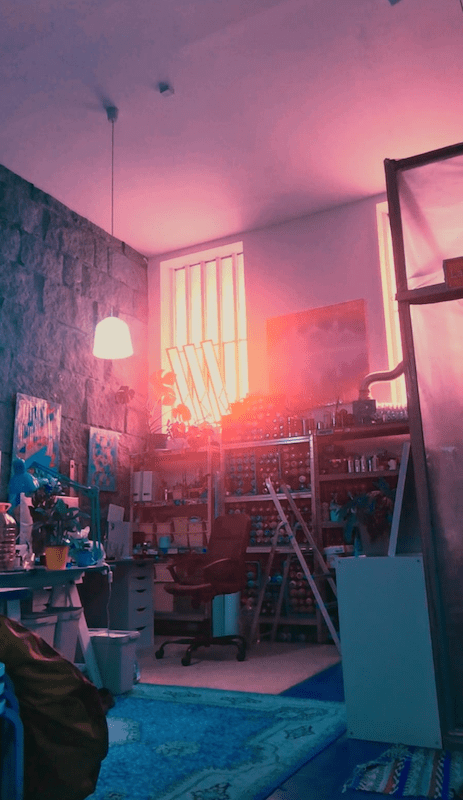
O meu ateliê situa se junto ao Marquês e aos Combatentes. Fica no complexo Lusolima. Foi um complexo desenhado por arquitetos e, entretanto, tornou se um marco da arquitetura aqui na zona. E uma característica que estes prédios têm é que rés-do-chão, as caves, por assim dizer, foram idealizadas para serem ateliês para artistas. E alguns deles foram feitos para artistas que os arquitetos conheciam. Por exemplo, se era um escultor, era feito de uma maneira. Se era um arquiteto, era de outra forma. Se era um pintor, tinha outras características. O ateliê onde eu estou foi do escultor Gustavo Bastos, penso que é assim o nome dele, se não estou em erro. Nós fizemos algumas adaptações – divido o atelier com o meu namorado também é artista, o Filipe Granja, cujo nome artístico é mynameisnotSEM https://www.instagram.com/mynameisnotsem/ – por exemplo, criamos um laboratório, por assim dizer, que é uma espécie de uma sala onde nós pintamos a spray, que é para não sujar um estúdio todo e não ter ali, por exemplo, os gases mais tóxicos concentrados.
O ateliê significa para mim um espaço de criação onde eu posso estar à vontade de fazer o que eu quiser. Exatamente, por ser um espaço que só é partilhado com outra pessoa acaba por ser quase uma segunda casa e eu posso dar asas à minha imaginação aqui. Também costumamos fazer Open Studios, em que permitimos a qualquer pessoa de ir visitar o nosso estúdio. Não está sempre aberto ao público, é um espaço assim, um bocadinho mais particular. Porém, existe essa possibilidade, contactando-me, de fazer uma visita. Estou disponível para isso consoante o meu calendário de trabalho. Podem visitar apenas, durante as visitas podem comprar, fazer perguntas. Também faço workshops aqui no estúdio de graffitti de arte urbana de vários temas relacionados com esses assuntos. O estúdio é o meu cantinho de criação.
Your studio is quite picturesque and is in a special place in Porto, I think. Where is it? What does the atelier mean to you since a lot of your art is made outside directly for the public?
My studio is located next to Marquês do Mar and Combatentes. It is in the Lusolima complex. It was a complex designed by architects and has since become a landmark of architecture in the area. And one characteristic of these buildings is that the ground floors, the basements, so to speak, were designed to be studios for artists. And some of them were made for artists that the architects knew. For example , it was done one way if it was a sculptor. If it was an architect, it was another way. If it was a painter, it had other characteristics. The studio where I am was owned by the sculptor Gustavo Bastos, I think that’s his name, if I’m not mistaken. We made some adaptations – I share the studio with my boyfriend, who is also an artist, Filipe Granja, whose artistic name is mynameisnotSEM https://www.instagram.com/mynameisnotsem/ – for example, we created a laboratory, so to speak, which is a kind of room where we spray paint, so as not to dirty the whole studio and not to have the most toxic gases concentrated there.
For me, the studio is a creative space where I can feel free to do whatever I want. Exactly, as it is a space that is only shared with one other person it ends up being almost a second home and I can give wings to my imagination here. We also usually do Open Studios, where we allow anyone to come and visit our studio. It’s not always open to the public, it’s a little bit more private. However, there is the possibility, by contacting me, to make a visit. I’m available for that depending on my work schedule. You can just visit, during the visits you can buy, ask questions. I also do workshops here at the studio on graffiti and urban art of various themes related to those subjects. The studio is my creative corner.
Já estiveste envolvida em vários projetos ao longo dos últimos anos, podes sinalizar alguns e explicar porque foram significativos?
Eu estive envolvido em vários projetos que eu gosto de destacar.
Um deles foi a participação no Festival Iminente, em 2019, no qual tive oportunidade fazer uma colaboração com a Underdogs Gallery e com a Seat. Pude fazer uma intervenção num carro em colaboração com o artista do audiovisual, que fez uma projeção de video mapping no carro e resultou extremamente bem. Ainda hoje é um dos projetos que eu mais gosto.
E depois disso também fiz um projeto um bocadinho diferente no interior do país, que foi para o Festival Moimenta da Beira. Pintei uma infraestrutura que havia na praça principal da vila, que era um antigo quiosque e estava um pouco degradado. Pintei-o completamente quase todas as superfícies, menos os vidros, claro. Dei-lhe uma vida completamente nova que só reforça todas as qualidades que a arte urbana tem – que é o poder de renovar os espaços. É um projeto que que ainda guardo no meu coração, porque até levou mais pessoas, àquela praça dano-lhe uma nova oportunidade.
Houve alguns projetos também, que fiz, nomeadamente no ano passado, também no interior do país – que é algo que me entusiasma fazer. Um desses projetos foi feito no âmbito do projeto Fôlego, um pequeno projeto dentro desse projeto, que era o Pigmentos, que era uma intervenção em 5 escolas do Concelho de Castelo Branco, Oleiros, Mação, Vila de Rei, Proença-a-Nova e Sertã. Todos eles sítios incríveis, muito interessantes. Fomos muito bem recebidos, e culminou com a pintura do mural em cada escola. É muito gratificante levar estes projetos a locais que, se calhar, não têm tantas oportunidades como aqui no litoral onde a cultura está mais concentrada. Foi um projeto também que integrou a sensibilização para as alterações climáticas, para os incêndios, numa zona em que esta sensibilização é muito importante. Foi fantástico.
You’ve been involved in several projects over the last few years, can you pinpoint a few and explain why they were significant?
I have been involved in several projects that I like to highlight.
One of them was participating in the Iminent Festival in 2019, in which I had the opportunity to do a collaboration with Underdogs Gallery and Seat. I was able to do an intervention in a car in collaboration with the audiovisual artist, who did a video mapping projection on the car and it worked extremely well. Even today it’s still one of the projects I like the most.
And after that I also did a slightly different project in the interior of the country, which was for the Festival Moimenta da Beira. I painted an infrastructure that existed in the main square of the village, which was an old kiosk and was a bit degraded. I painted almost all the surfaces completely, except the glass, of course. I gave it a completely new life that only reinforces all the qualities that urban art has – which is the power to renew spaces. It is a project that I still keep in my heart, because it even brought more people to that square and gave it a new opportunity.
There were also some projects that I did, namely last year, also in the interior of the country – which is something I am very enthusiastic about doing. One of those projects was done within the scope of the Fôlego project, a small project within that project, which was Pigmentos, which was an intervention in 5 schools in the municipality of Castelo Branco, Oleiros, Mação, Vila de Rei, Proença-a-Nova and Sertã. All of them incredible places, very interesting. We were very well received, and it culminated with the painting of the mural in each school. It’s very gratifying to take these projects to places that, perhaps, don’t have as many opportunities as here on the coast, where culture is more concentrated. It was also a project that integrated awareness raising on climate change, on fires, in an area where this awareness is very important. It was fantastic.

Tens várias páginas profissionais, podes indicar aquela onde tens mais informação e até mesmo trabalhos que as pessoas possam consultar?
O meu trabalho pode ser visto online e principalmente na plataforma Instagram, (@marianaptks ) que é onde eu publico a maior parte dos meus projetos. No entanto, não tenho uma obsessão de ter ali o meu trabalho todo ou quase ao minuto, porque acho que isso torna a vida do artista desnecessariamente complicada e, embora tenhamos que nos manter up to date com as tecnologias, elas também não se podem tornar um bicho que nos consome. Gosto de ir publicando os meus trabalhos também para as pessoas ficarem atualizados e poderem consultar também usou o Facebook, na medida em que o que eu publico no Instagram publica também no Facebook. Assim, mantenho ali dois públicos atualizados. De resto, tenho uma loja online, no site Etsy, onde tenho todo o tipo de trabalhos, desde séries limitadas de prints inéditos a obras originais em madeira, em tela, um pouco de tudo.
You have several professional websites, can you indicate the one where you have more information and even work that people can consult?
My work can be seen online and mainly on the Instagram platform, (@marianaptks) where I publish most of my projects. However, I don’t have an obsession with having my work there all or almost all the time, because I think that makes the artist’s life unnecessarily complicated and, although we have to keep up to date with technologies, they can’t become a bug that consumes us either. I like to keep publishing my work so that people stay up to date and can also consult it using Facebook, because what I publish on Instagram I also publish on Facebook. So, I keep two audiences up to date there. Besides, I have an online shop, on the Etsy website, where I have all kinds of works, from limited series of unpublished prints to original works in wood, on canvas, a bit of everything.

Se alguém quisesse fazer uma road trip e ver as tuas obras públicas onde as poderia encontrar? Tens um roteiro de pinturas murais?
E é possível ver as minhas obras um pouco por todo o Portugal, mas também no estrangeiro e penso que neste momento, apenas na Bélgica, em Gante, porque todas as outras eram projetos em que as paredes eram renovadas de meio em meio ano, ou algo parecido, por isso, já não podem ser vistas. Nesses projetos temporários passei por: Thessaloniki, na Grécia em 2017; em Mouans Sartoux, França, 2021 pelo projecto Street Art Festival e pelo projecto Le Murquem. Sei que em breve posso vir a ter uma obra num local um bocadinho mais perto, num local onde vivem muitos portugueses, mas para já é surpresa.
If someone wanted to go on a road trip and see your public works where could they find them? Do you have a route for wall paintings?
It is possible to see my works all over Portugal, but also abroad and I think at this moment only in Belgium, in Ghent, because all the others were projects where the walls were renewed every half year or so, so they can no longer be seen. In those temporary projects I went through: Thessaloniki, Greece in 2017; in Mouans Sartoux, France, 2021 for the Street Art Festival project and the Le Murquem project. I know that soon I may have a work in a place a little closer, in a place where many Portuguese live, but for now it is a surprise.
Onde gostavas mais de deixar a tua marca, um trabalho especial?
Aonde eu queria mais pintar era no Porto, na minha cidade. O meu desejo é ter uma parede comissionada pela Câmara do Porto. Tem sido um bocadinho complicado para mim, e para muitos artistas da cidade. É difícil arranjar um lugar para pintar e autorização para o fazer. Porque são decisões que não partem de nós, e quem toma muitas vezes já tem essas decisões tomadas há alguns anos, já existem listas de espera, se é que assim lhes podemos chamar. Aqui no Porto as coisas sempre foram um bocadinho mais fechadas, a nível de abertura à Arte Urbana. É um problema que vem desde os tempos do Rui Rio. Entretanto, tem havido um esforço coletivo para arranjar paredes para os artistas, para arranjar paredes legais, para quem quiser pintar. Fico a contar os segundos até a minha oportunidade aparecer. Mas espero que este ano ou em 2024 seja o ano em que eu finalmente possa ter uma parede e que possa dizer às pessoas interessadas: «podem ir ver o meu mural ali no Marquês» ou «ali no Carolina Michaelis», mas não ainda não é possível.
E eu sempre tentei trabalhar à volta disso, e isso nunca foi algo que que me desmoralizou ou coisa do género. Eu sempre fiz por fazer criações artísticas noutros sítios. Tenho uma criação nos Bombeiros Voluntários Portuenses, na zona industrial do Porto, perto da estação de metro de Ramalde.
Where would you most like to leave your mark, a special work?
The place I would most like to paint is Oporto, in my city. My wish is to have a wall commissioned by Porto City Hall. It has been a bit complicated for me, and for many artists in the city. It’s difficult to find a place to paint and permission to do so. Because these are decisions that don’t come from us, and those who make them often have already taken them a few years ago; there are already waiting lists, if you can call them that. Here in Oporto things have always been a little more closed, in terms of openness to Urban Art. It’s a problem that comes from the times of Rui Rio. However, there has been a collective effort to arrange walls for artists, to arrange legal walls, for whoever wants to paint. I’m counting the seconds until my opportunity appears. But I hope that this year or in 2024 will be the year that I can finally have a wall and that I can tell interested people: “you can go and see my mural over there in Marquês” or “over there in Carolina Michaelis”, but it’s not possible yet.
And I’ve always tried to work around that, and it’s never been something that has demoralised me or anything like that. I’ve always tried to make artistic creations in other places. I have a creation at Bombeiros Voluntários Portuenses, in the industrial area of Porto, near Ramalde metro station.
 IPM Monthly