

Kuma’s Onomatopoeia: a Quest for Materiality’s Essence
By Eduarda Machado

October 2025 – The critically acclaimed exhibition, Kengo Kuma: Onomatopoeia, is captivating audiences on a multi-city tour, offering an immersive journey into the innovative architectural philosophy of the renowned Japanese architect. Having already graced major European cities, the tour is a co-production between Kengo Kuma’s office and various cultural institutions. It commenced its journey at the Palazzo Franchetti in Venice, Italy, from May to November 2023, before moving to the Bundeskunsthalle in Bonn, Germany, from March to September 2024, and then to Athens, Greece, from January to March 2025.
This exhibition showcases Kuma‘s unique design approach, where he masterfully translates the sounds and feelings of materials into tangible architectural forms. At the heart of the experience is Kuma’s exploration of the inherent textures of materials like wood and stone, and his own personal search for the «essence of materiality» – using Kuma’s words during his presentation last Saturday 4th October. Through a collection of intricate models, stunning photographs, detailed drawings, and immersive installations, visitors can explore a retrospective of his most significant projects.

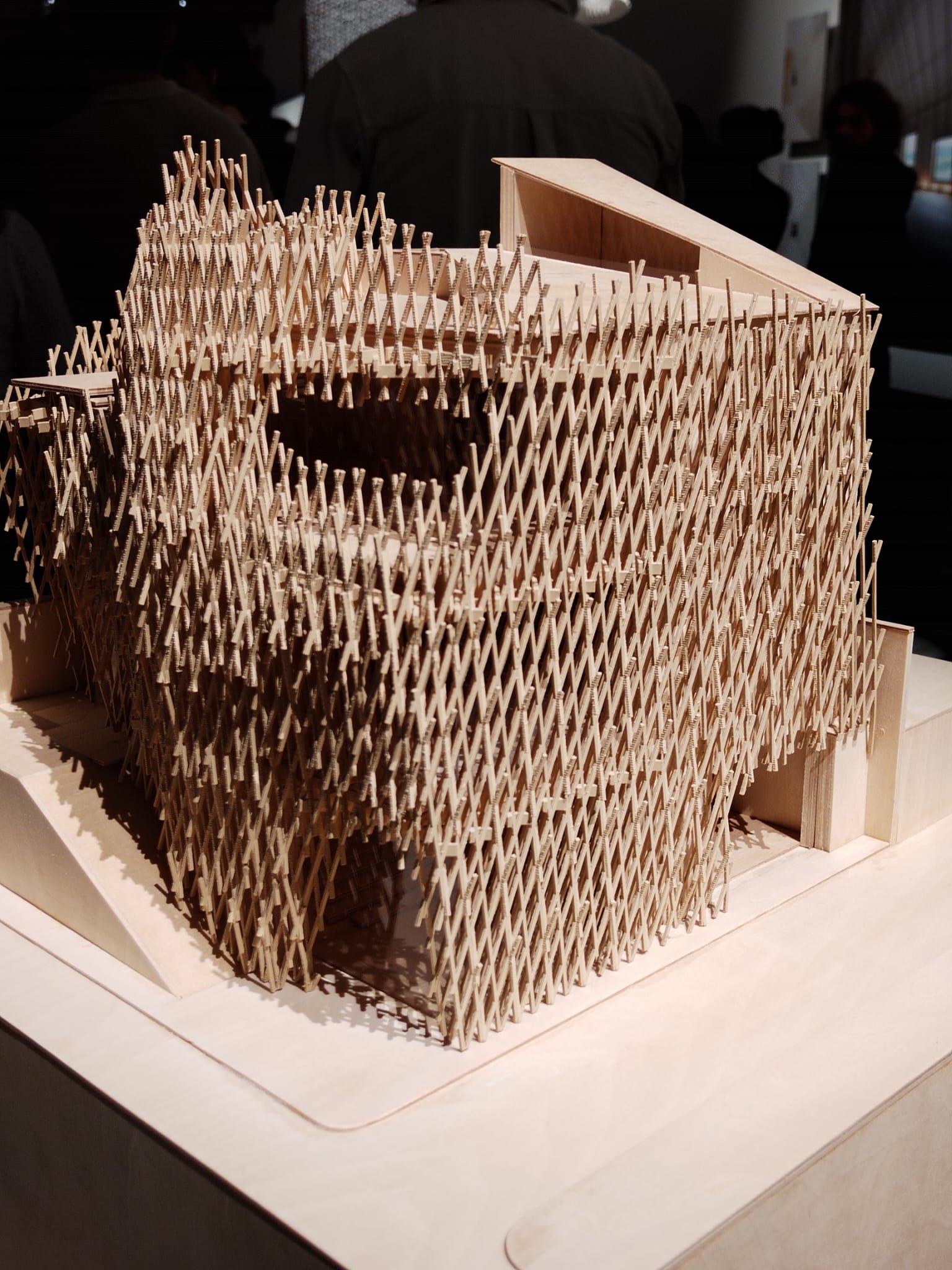
His work is imbued with conceptual intent. He unpretentiously acknowledges his inspiration from Japanese sacred architecture. His admiration for the past, together with his fascination for simple, raw materials, allows his work to elevate them from their pure and raw state to their most ethereal one. This, in turn, allows Kuma’s ability to convey the sacred through material simplicity to be felt in all his work. Its architecture thus becomes a symbiosis between the functional role of architecture and its power to lift the spirit, contributing to the common good and communion with nature. Its impressionistic richness stems from visual textures that resonate deeply, creating a visual chord that vibrates beneath the gaze and conjuring the color of pure emotion that floods the void where pigment is absent. From a technical point of view, Kengo excels in Da Vinci-like simplicity, using the application and distribution of weights, allowing the structure of his architecture to be self-sustaining and not resorting to complementary supports such as nails, screws, among others. Thus, he designs architectural elements from scratch, with advanced technology and highly innovative resource economisation.


Currently, the exhibition has arrived in Portugal and is being hosted at the Casa da Arquitectura – Portuguese Centre for Architecture in Matosinhos, where it will be on display until March 8, 2026. According to Casa da Arquitectura’s website, this Portuguese edition has been tailored with a unique character, incorporating projects Kuma has developed or is currently undertaking in the country. Namely, the architectural reconstruction of the old Porto’s Matadouro (slaughterhouse) and the reconstruction of three abandoned villages in Serra da Lousã for future tourist destinations.
The presentation features 22 models, 67 photographs of 19 projects, and 13 drawings and texts dedicated to onomatopoeias selected specifically for this venue. The exhibition design, overseen by Kuma’s studio, has been carefully adapted to the hall of the Casa da Arquitectura. To enrich the experience, a parallel program of activities is planned, including guided tours, workshops, and traditional Japanese ceremonies like Taiko drum performances and tea ceremonies, offering a deeper dive into the intersection of Japanese culture and architecture.

Kengo Kuma’s writings offer a fascinating architectural philosophy. In Anti-Object, he critiques the dominant Western ‘object’ tradition in favor of ephemeral, subordinate architecture that allows the environment to prevail. Material Immaterial further explores this by focusing on how traditional Japanese materials – wood, paper, and stone – can be used to create spaces that feel both present and dissolving, bridging the gap between physical substance and sensory perception. Finally, Architecture of Defeat frames his designs as a humble response to nature and history, rejecting the monumental hubris of modernism, a concept that resonates with post-structuralist and existential critiques of power and grand narratives. These books collectively propose a phenomenological architecture rooted in material humility and contextual permeability.
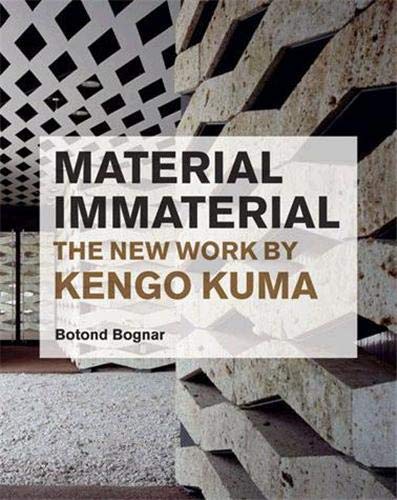


Kengo Kuma: Onomatopoeia certainly is an unprecedented opportunity to engage with Kengo Kuma’s work – an exhibition that exudes sensibility and elegance. This approach is the result of a deep philosophical quest to understand the essence of materiality, where Kuma advocates for an architecture that finds its soul in humble materials and its purpose in contextual harmony. I could not help but share this chance to experience this retrospective, featuring intricate models and immersive installations.
©️Eduarda Machado | “Kuma’s Onomatopoeia: a Quest for Materiality’s Essence.”, IPM Monthly 4/10. (2025).
 IPM Monthly